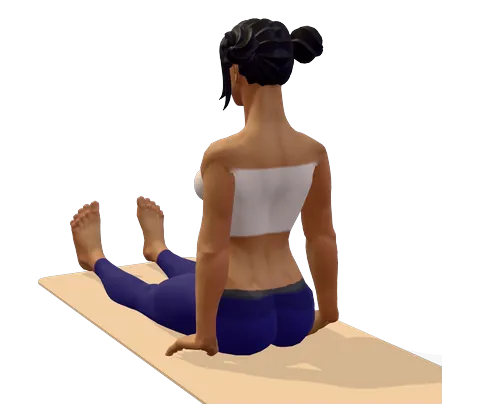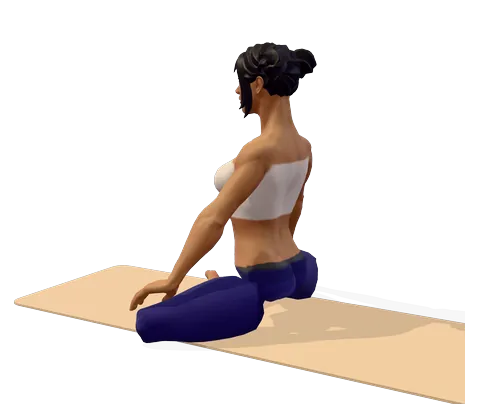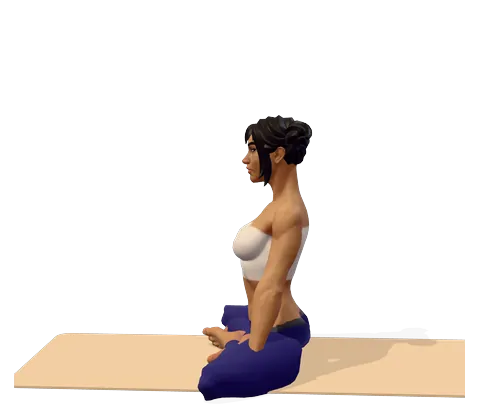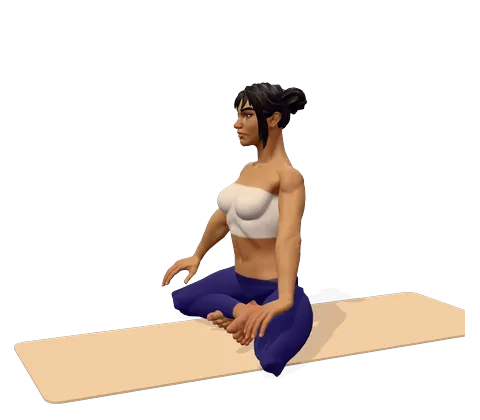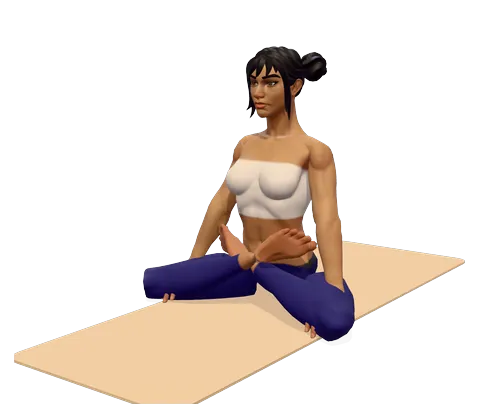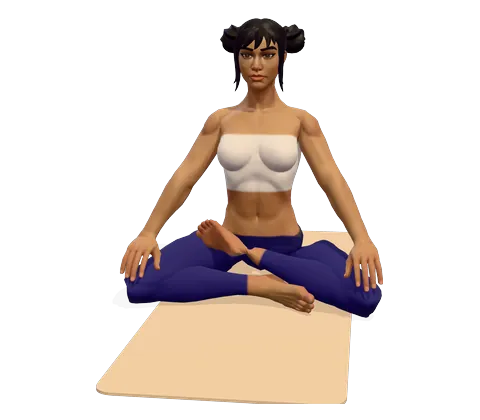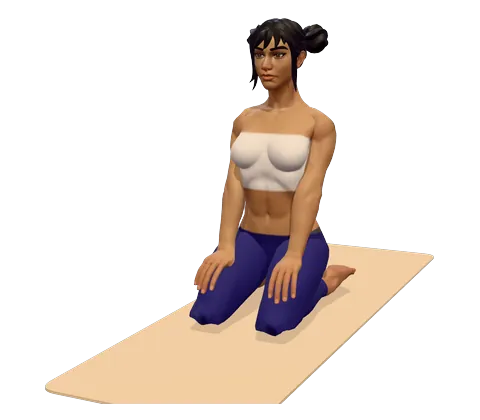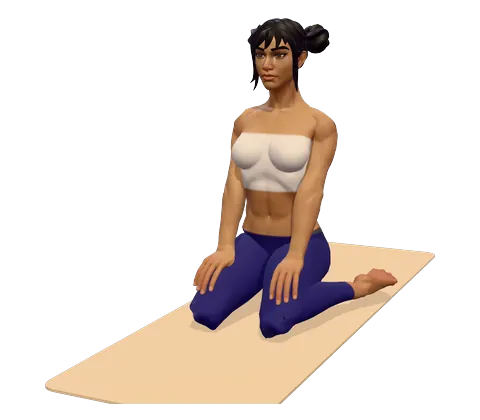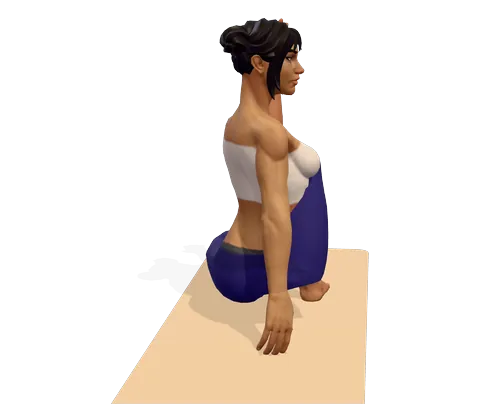
How to do Marichi’s Pose step by step
- Sit tall with both legs straight in front of you. Sit on a folded blanket if your lower back rounds.
- Bend your right knee and place the right foot flat on the floor close to your right sitting bone. Keep the left leg straight and active, toes pointing up.
- Place your right hand on the floor behind you, close to your back, and lift up through the crown of your head.
- Breathe in and raise your left arm. Breathe out, turn to the right and press the back of your left upper arm or elbow against the outside of your right knee.
- Keep both sitting bones grounded. Grow taller as you breathe in and turn a little more from the belly as you breathe out. Look over your right shoulder if your neck is comfortable.
- Hold for 3–6 breaths (about 30 seconds). If your spine stays upright, you can wrap the left arm around the knee and clasp the right hand behind your back.
- Breathe out to unwind, straighten the right leg and repeat on the other side.
Where you feel Marichi’s Pose: what it stretches and strengthens
Hug the bent knee and rotate from your waist. In the 3D guide, turn on Body guide: areas that stretch glow green and areas that work glow saffron.
Stretches
- Side waist
- Glutes
- Shoulders
Strengthens
- Spine
Benefits and precautions
Benefits
- Rotates the spine and keeps the back muscles supple
- Stretches the outer hip of the bent leg, the chest and the shoulders
- Keeps the straight leg working, with a light hamstring stretch
- The forward-bending versions (A and B) give a deep hamstring and shoulder stretch
- Gently squeezes the belly; traditionally practised to support digestion
- Builds the control you need for deeper twists and binds
Avoid or modify if
- Pregnancy — avoid closed twists and deep forward folds; ask your midwife about gentle alternatives
- Disc herniation, sciatica or acute back pain — keep the twist small or skip it
- Knee injury — avoid versions B and D, which use half lotus
- Shoulder injury — do not bind; keep the arm against the knee or use a strap
- Osteoporosis — no forced or deep twisting; ask your doctor what suits you
- Recent abdominal surgery or hernia — skip it until your doctor clears you
Marichi's pose (Marichyasana) is not one pose but a family of four seated poses that share the same leg shape: one leg straight, the other knee bent with the foot on the floor. Two of them are forward bends and two are twists. The one most people mean — and the one our 3D guide shows — is Marichyasana C, a seated twist toward the bent knee. This page explains all four, how to do the twist well, what the poses are good for and who should skip them.
Marichyasana meaning: who was Marichi?
In Hindu tradition Marichi is one of the sages born from the mind of Brahma, the creator, and is counted among the seven great sages (Saptarishi). Through his son Kashyapa he is the grandfather of Surya, the sun god, and his name itself means "ray of light". So the Marichyasana meaning in English is simply "pose dedicated to the sage Marichi", which is why yoga books also call it sage Marichi pose. The Marichyasana meaning in Sanskrit is literally "Marichi + asana", the pose of Marichi. In Hindi it is मरीच्यासन.
All Marichyasana variations: A, B, C, D (1, 2, 3, 4) compared
Ashtanga yoga names the versions with letters; Iyengar yoga numbers them. Marichyasana 1 matches A, 2 matches B, 3 (or III) matches C, and 4 matches D.
| Version | Legs | Movement | Level |
|---|---|---|---|
| A / 1 | One knee bent, foot near the sitting bone; other leg straight | Forward bend; the arm wraps the bent shin and the hands clasp behind | Intermediate |
| B / 2 | One leg in half lotus, other knee bent | Forward bend with the same bind | Advanced — needs open hips and healthy knees |
| C / 3 | As in A | Twist toward the bent knee, opposite arm outside the knee | Intermediate — shown in 3D |
| D / 4 | As in B | Twist toward the bent knee with a bind | Advanced |
How to do Marichyasana C correctly
Follow the Marichyasana 3 steps above, then check these points:
- Foot close, knee up. The bent-knee foot sits near the sitting bone, a little away from the straight leg, so the knee points to the ceiling.
- Arm and knee press into each other. That gentle push lengthens and turns you; do not yank yourself round.
- Height beats depth. If your back rounds, stop turning and sit higher on a blanket.
- Bind only with a tall spine. Clasping the hands behind while slumped moves the strain into the lower back.
If a teacher offers a Marichyasana C adjustment, it should feel like help to sit taller, never like a forced turn.
How to do Marichyasana A
Set up the legs the same way. Reach the arm on the bent-knee side forward, wrap it around the shin, and clasp the other hand behind your back. Then fold forward over the straight leg with a long spine. Marichyasana 1 for beginners: skip the bind and hold the straight leg's foot, or a strap around it.
Marichyasana B and D
The steps for Marichyasana B and D both start with one foot in half lotus and the other knee bent. B folds forward; D twists. They put real load on the half-lotus knee, so leave them until half lotus is completely comfortable, and learn them with an experienced teacher.
Marichyasana benefits
The twisting versions keep the spine mobile, stretch the outer hip of the bent leg and open the chest and shoulders. The Marichyasana C benefits people notice most are a looser upper back and easier turning, useful for driving or reversing a car. The forward-bending versions add a strong hamstring stretch and, with the bind, a deep stretch for the fronts of the shoulders.
Tradition says twists and folds "massage" the abdominal organs and support digestion. That is not well tested, but the pose sits comfortably in a digestion-friendly routine. For stiffness in the back, gentle twists are often welcome; with a disc problem, see our yoga for back pain plan and keep twists small.
Marichyasana muscles
| Stretches | Works |
|---|---|
| Obliques and spinal rotators (C, D) | Opposite obliques, which create the twist |
| Outer hip and buttock of the bent leg | Back extensors, which keep you upright |
| Hamstrings of the straight leg (A, B) | Quadriceps of the straight leg |
| Chest and front of the shoulders (in the bind) | Muscles between the shoulder blades |
Marichyasana for beginners: modifications and prep
These Marichyasana C modifications and variations make the twist easier:
- Hug the knee with the opposite arm instead of pressing the elbow outside it.
- Use a strap between the hands if they cannot meet in the bind.
- Bend the straight leg slightly if the hamstrings pull the back into a curve.
- Standing Marichyasana variations: put one foot on a chair seat and twist toward that knee — a good option if sitting on the floor is hard.
Good Marichyasana C prep poses are head-to-knee pose for the hamstrings, cow face pose for the shoulders and a gentle lying twist for the spine.
Marichyasana C vs Ardha Matsyendrasana
In Marichyasana C the bottom leg stays straight; in Ardha Matsyendrasana it folds under, and the top foot crosses over to the outside of the knee. Marichyasana C feels more upright and works the straight leg; Ardha Matsyendrasana asks more of the hips. Vakrasana vs Marichyasana: Vakrasana is the simpler twist often taught in India, with the hands supporting you and no bind. Bharadvaja's twist is another gentle alternative.
Marichyasana contraindications and precautions
The caution box above lists who should avoid or modify these poses. The main risks are rounding the back while twisting or binding, and forcing a half-lotus knee in B and D. Stop at any sharp pain in the knee or back. A gentle pull in the side body and hip is normal; pinching is not.
Marichyasana sequence
In the Ashtanga primary series the four versions come straight after Janu Sirsasana and before boat pose. In a home or Hatha yoga practice, place Marichyasana C after forward bends and hip openers, and finish with a neutral forward fold. You can mix twists and folds into your own flow with the guided sessions.
मरीच्यासन (Marichyasana in Hindi): दोनों पैर सामने फैलाकर बैठें। दायाँ घुटना मोड़ें और पैर को दाएँ कूल्हे के पास ज़मीन पर रखें। दायाँ हाथ पीछे रखें, साँस छोड़ते हुए दाईं ओर मुड़ें और बाईं कोहनी को दाएँ घुटने के बाहर लगाएँ। 30 सेकंड रुकें, फिर दूसरी तरफ़ करें। मरीच्यासन के फायदे (Marichyasana ke fayde): रीढ़ लचीली होती है, कूल्हे और कंधे खुलते हैं और पाचन में सहायता मिल सकती है। गर्भावस्था, स्लिप डिस्क या घुटने की चोट में यह आसन न करें।
Frequently asked questions
What are the benefits of Marichyasana?
The twisting versions (C and D) mobilise the spine, stretch the outer hips and open the shoulders. The forward-bending versions (A and B) stretch the hamstrings and shoulders. All of them build body awareness for deeper poses.
How do I do Marichyasana C step by step?
Sit with one leg straight, bend the other knee with the foot near your sitting bone, place the same-side hand behind you, sit tall, then turn toward the bent knee and press the opposite elbow against the outside of it. Hold 3–6 breaths and change sides.
Marichyasana A vs C: what is the difference?
The legs are the same. In A you wrap the arm around the bent shin, bind and fold forward over the straight leg. In C you twist toward the bent knee with the opposite arm outside it.
What is Marichyasana 3?
Marichi's pose 3 (Marichyasana III) is the Iyengar name for the seated twist that Ashtanga calls Marichyasana C.
Is Marichyasana C the same as Ardha Matsyendrasana?
No. In Marichyasana C the bottom leg stays straight. In Ardha Matsyendrasana it folds under you and the top foot crosses to the outside of the knee.
What are the Marichyasana benefits, precautions and contraindications?
Benefits: spinal mobility, hip and shoulder opening and hamstring length. Contraindications: pregnancy, acute disc or back problems, knee injury (for the half-lotus versions), shoulder injury (skip the bind), osteoporosis and recent abdominal surgery.
What is the Marichyasana meaning in Hindi?
मरीच्यासन — the pose of the sage Marichi (मरीचि), whose name means "ray of light".
This page is for general education. Check with your doctor before starting yoga if you are pregnant, have a medical condition or an injury. Stop if you feel pain, dizziness or shortness of breath.