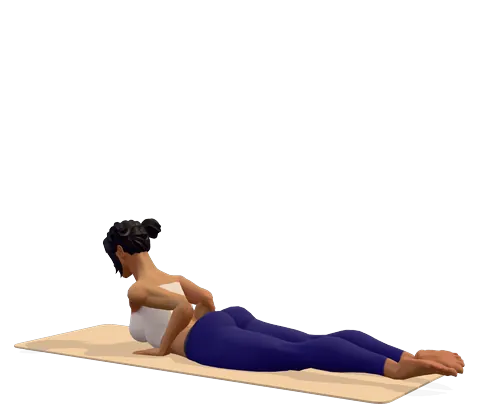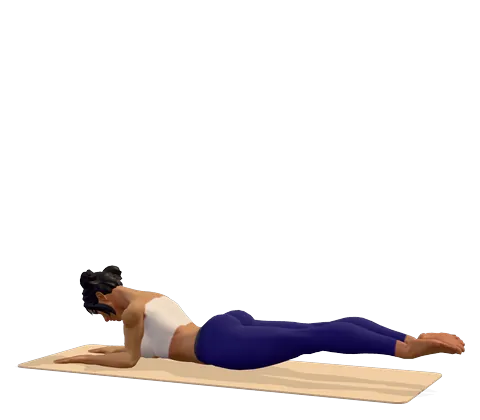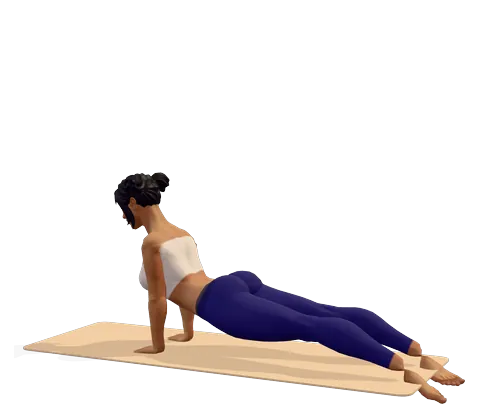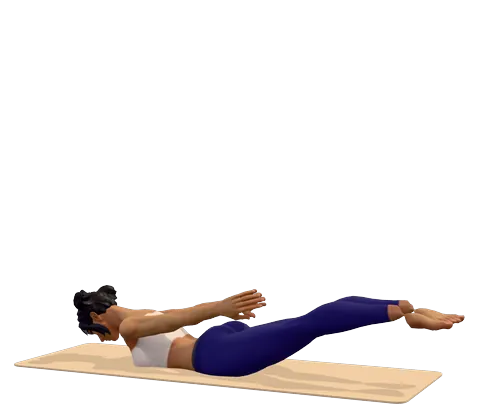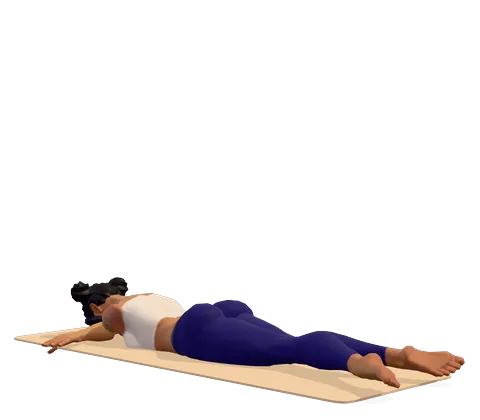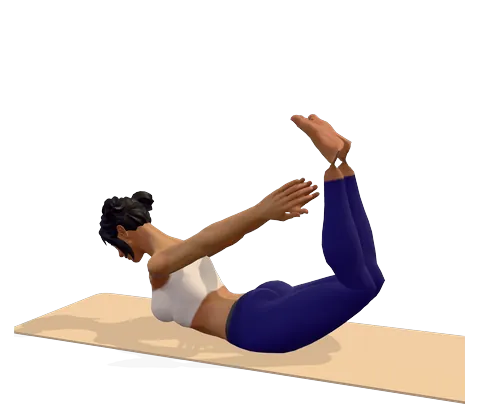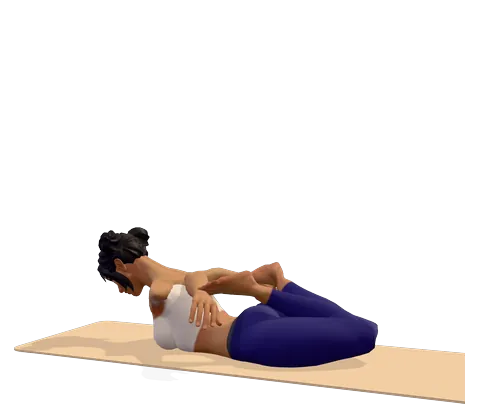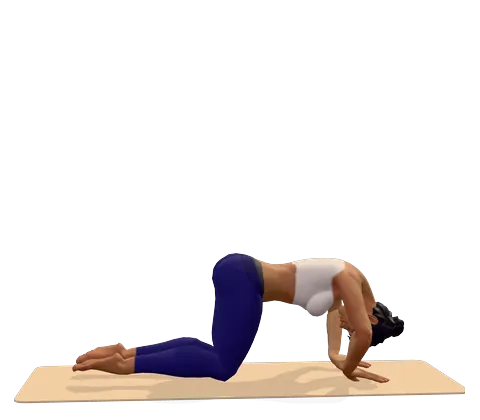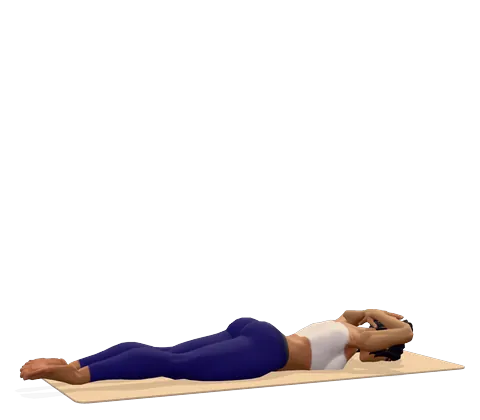
How to do Superior Posture step by step
- Lie on your front with your legs straight and a little apart, the tops of your feet on the mat.
- Rest your forehead on the mat. Use a thin folded towel under it if the floor is hard.
- Interlace your fingers and place your hands lightly on the back of your head, near the base of the skull.
- Let your elbows open out to the sides and rest toward the floor. Your arms should feel heavy, not active.
- Relax your lower back, buttocks and legs. Do not press your head down with your hands.
- Breathe slowly and feel the lower back rise a little on each breath in. Stay for about a minute.
- To come out, release your hands, place them under your shoulders, turn your head to one side and rest before you get up.
Where you feel Superior Posture: what it stretches and strengthens
Rest your forehead down and relax your back completely. In the 3D guide, turn on Body guide: areas that stretch glow green and areas that work glow saffron.
Stretches
- Lower back
Benefits and precautions
Benefits
- Gives the back a complete rest after prone backbends such as cobra and locust
- Gently lengthens the lower back as the muscles let go
- Makes breathing into the back and belly easy to feel
- Traditionally used to ease back and neck stiffness from long sitting
- Can help you settle and calm down in a few minutes
Avoid or modify if
- Pregnancy — do not lie on your belly; rest on your left side instead
- Recent abdominal surgery or a painful hernia
- Shoulder pain with the hands behind the head — rest your arms by your sides instead
- Neck pain — keep the hands very light or turn your head to one side on a folded towel
- Breathing trouble or a blocked nose when face down — rest on your back or side
Jyestikasana (superior posture) is a resting pose done lying face down with the hands clasped behind the head. It looks like very little is happening, and that is the point: the back muscles switch off and the lower back lengthens and settles. It is used between prone poses such as cobra and locust, or on its own when the back feels tired from sitting. This page explains how to do Jyestikasana, its benefits, how it compares with other resting poses, and how it fits into the wider question of good posture.
What is Jyestikasana?
Jyestikasana (also spelled Jyeshtikasana) is one of the prone relaxation poses taught in traditional hatha yoga, along with Advasana and Makarasana. In each, you lie on your front and let the body rest. What makes Jyestikasana different is the arm position: the fingers are laced behind the head and the elbows rest out to the sides.
Jyestikasana meaning
The name comes from the Sanskrit jyeshtha, which means "eldest", "best" or "superior", and asana, "pose". That is why it is called the superior posture or superior position. Superior position meaning in Hindi: ज्येष्ठ or श्रेष्ठ स्थिति — the "best" or "senior" position. The name describes its value as a rest, not a difficult shape.
How to do Jyestikasana (Jyestikasana kaise kare)
The steps above follow the 3D figure. A few details help the body really let go:
- Light hands: the hands only rest on the back of the head. They should not push the forehead into the floor.
- Heavy elbows: let the elbows sink out to the sides. If they hover and your shoulders ache, slide the hands lower toward the neck or rest the arms by your sides.
- Space for the nose: rest on the forehead, not the nose. A thin towel under the forehead gives the nose more room.
- Soft lower back: let the buttocks and legs relax so the lower back can lengthen. If it aches, place a thin pillow under your belly.
What you should feel: the back slowly softening, the breath moving the lower ribs and lower back, and the body growing heavier with each breath out.
Jyestikasana benefits
Jyestikasana benefits are simple but useful. It gives the back a full rest after effort, lets the lower back muscles release, and makes breathing into the back of the body easy to feel. Some traditional hatha yoga schools recommend it for back and neck stiffness and for people who stoop after long hours of sitting. These uses come from tradition rather than research, so think of the pose as a comfortable rest that supports, not replaces, treatment.
Jyestikasana vs Advasana and Makarasana
| Pose | Arms | Feels like |
|---|---|---|
| Jyestikasana (superior posture) | Hands clasped behind the head, elbows out | Deep rest for the back; a light opening across the chest |
| Advasana (reverse corpse pose) | Stretched forward over the head | Rest with a gentle stretch for the shoulders and sides |
| Makarasana (crocodile pose) | Folded, forehead or chin on the forearms | Easy belly breathing; good for beginners |
Try all three and use the one that lets your back relax most. For a face-up rest, use Savasana.
Jyestikasana for back pain
People with mild back stiffness often find lying on the front with the back fully relaxed comfortable, and it is a good rest between gentle postures to relieve back pain such as sphinx and cobra. It is not a cure. If you have a disc problem, spinal stenosis or pain spreading into a leg, ask your doctor or physiotherapist which posture for lower back pain suits you, and keep any treatment they prescribe. See yoga for back pain for a full plan.
Why is good posture important?
Because the pose is called superior posture, many people arrive here wondering how important posture really is. Why is good posture important, and why is proper posture important for comfort? When the head, ribs and pelvis are stacked, the muscles and joints share the load evenly, so you can sit and stand longer before you feel tired or stiff. Does good posture help with pain? Research on this is mixed: no single "perfect" posture prevents back pain, and moving often seems to matter more than holding one position. So how important is good posture? Posture is good for health mainly as part of an active day, not as a rigid rule.
Benefits of good posture
The pros of good posture include less strain on the neck and shoulders, easier breathing when the chest is open, and a feeling of steadiness. Benefits of upright posture are easiest to keep when your back and core are strong and your hips and chest are not tight — which is where yoga helps. The benefits of maintaining proper body posture add up over years, which is the real importance of good posture; the importance of correct posture is about habits, not a fixed pose.
Good sitting posture for lower back pain
There is no one best sitting posture for lower back pain, but these habits for a proper sitting posture help most people with lower back pain:
- Sit back in the chair with both feet flat and the knees about level with the hips.
- Support the curve of the lower back with the chair or a small cushion.
- Bring the screen to eye level so the head does not drift forward.
- Get up and move every 30–45 minutes; this matters as much as correct sitting posture for lower back pain.
Good sitting posture for back pain works best with a few minutes of yoga each day. Standing in Tadasana teaches the stacked, upright shape, and simple Tadasana exercises for back pain, such as reaching the arms up and swaying gently side to side, wake up the trunk. See yoga for posture and yoga for office workers for full sessions.
ज्येष्ठिकासन (Jyestikasana) — हिंदी में: पेट के बल सीधे लेट जाएँ और माथा ज़मीन पर रखें। दोनों हाथों की उँगलियाँ आपस में फँसाकर सिर के पीछे हल्के से रखें, कोहनियाँ बगल में ज़मीन की ओर ढीली छोड़ें। पीठ, कमर और पैरों को पूरी तरह ढीला छोड़कर लगभग एक मिनट धीमी साँस लें। यह आसन पीठ को आराम देता है और लंबे समय तक बैठने की थकान कम करने में मदद कर सकता है। गर्भावस्था में पेट के बल न लेटें।
Frequently asked questions
How do you do Jyestikasana?
Lie on your front with your legs straight, rest your forehead on the mat, interlace your fingers behind your head and let your elbows rest out to the sides. Relax your whole back and breathe slowly for about a minute.
What are the benefits of Jyestikasana?
It gives the back a full rest, lets the lower back muscles release after backbends and makes breathing into the back easy to feel. It is traditionally used for back and neck stiffness.
Why is Jyestikasana called superior posture?
The name comes from the Sanskrit jyeshtha, meaning eldest, best or superior. It refers to its value as a restful position, not to a difficult shape.
Is Jyestikasana good for beginners?
Yes. It needs no strength or flexibility. If your shoulders are stiff, rest your arms by your sides instead of behind your head.
How long should I stay in Jyestikasana?
About a minute between poses, or longer if you find it restful.
Who should not do Jyestikasana?
Avoid it in pregnancy and after recent abdominal surgery. With shoulder or neck pain, keep the hands very light or rest the arms by your sides.
This page is for general education. Check with your doctor before starting yoga if you are pregnant, have a medical condition or an injury. Stop if you feel pain, dizziness or shortness of breath.