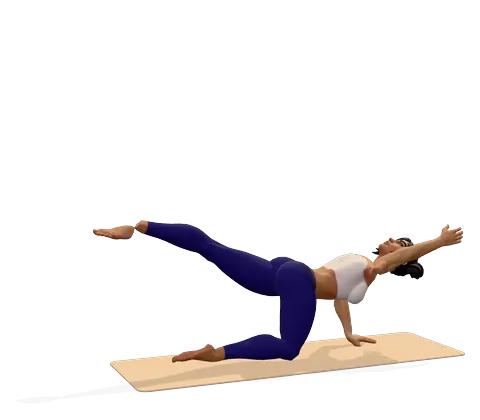
How to do Tiger Pose step by step
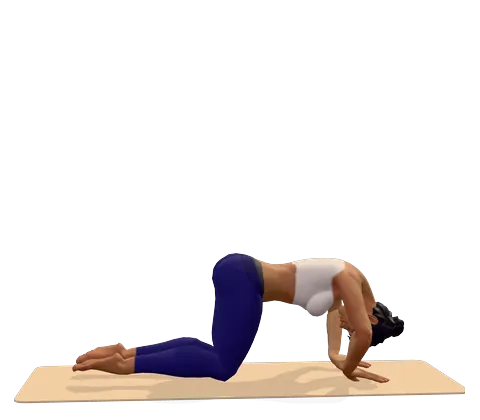
- Come onto your hands and knees. Place your wrists under your shoulders and your knees under your hips, with your back flat.
- Look down at the mat so your neck stays in line with your spine. Draw your belly gently in.
- Slide your left leg back along the mat, then breathe in and lift it until it is level with your hip, toes pointing down.
- When you feel steady, reach your right arm forward to shoulder height, thumb pointing up.
- Keep both hips level, as if a cup of water were resting on your lower back. Stretch long from your fingertips to your heel.
- Hold for 3–5 breaths, then breathe out and lower your arm and knee back to tabletop.
- Repeat with the right leg and the left arm. Rest in child's pose afterwards.
Where you feel Tiger Pose: what it stretches and strengthens
Reach your leg back and up while keeping hips square. In the 3D guide, turn on Body guide: areas that stretch glow green and areas that work glow saffron.
Stretches
- Hip flexors
- Chest
Strengthens
- Glutes
- Lower back
- Abs
Benefits and precautions
Benefits
- Strengthens the muscles along the spine, the buttocks and the back of the shoulders
- Trains the deep core muscles that keep the back steady
- Improves balance and coordination between opposite arm and leg
- Stretches the front of the hip on the lifted-leg side
- A gentle, low-load back exercise that suits most beginners
- The knee-to-nose version also mobilises the spine like cat-cow
Avoid or modify if
- Knee pain — pad the supporting knee with a folded blanket
- Wrist pain or carpal tunnel — keep the lifted arm on the floor, or use fists
- Acute back pain — lift the leg only a little and stop if pain increases
- Shoulder injury — skip the arm lift and keep both hands on the mat
- Pregnancy — keep the leg low and the belly supported; avoid the deep knee-to-nose curl
Tiger pose (Vyaghrasana) is a balancing pose on hands and knees in which one leg stretches back and, in the version our 3D guide shows, the opposite arm reaches forward. It looks simple, but holding the hips level while you stretch long asks a lot of the back and core muscles. It is a gentle strength exercise for the back, a favourite in yoga for kids, and a good bridge between warm-ups and stronger poses.
What is tiger pose in yoga?
The tiger pose yoga name in Sanskrit, Vyaghrasana, comes from vyaghra, "tiger", and asana, "pose". A simple tiger pose Sanskrit pronunciation is "vyah-GRAH-sah-nah". The long line from hand to heel is said to look like a tiger stretching after sleep.
Different schools teach slightly different shapes under the same tiger pose asana name:
- Extended tiger (shown in 3D): leg straight back at hip height, opposite arm forward. Many fitness classes call a similar exercise "bird dog".
- Classical Vyaghrasana: taught in many Indian schools. The lifted leg bends so the foot reaches toward the head, the gaze lifts, and on the breath out the knee comes in toward the nose.
- Tiger curl: the knee-to-nose movement repeated slowly with the breath, rounding the back each time.
In yoga terms, all three are one tiger posture with different details: a four-point base, one limb (or two) lifted, and a slow link with the breath.
How to do tiger pose in yoga
The tiger pose yoga steps above build it in stages. In some Indian classes you begin kneeling in thunderbolt pose; see how to do Vajrasana if that is new to you. Then you come forward onto your hands. These tiger pose yoga cues fix the usual problems:
- Hips level. The hip of the lifted leg tends to swing up and open. Point the toes of the lifted foot straight down and keep both hip bones facing the floor.
- Leg long, not high. Lifting above hip height usually means the lower back is sagging. Reach the heel back instead of up.
- Push the floor away. Press the standing hand down so the shoulder does not collapse toward the ear.
- Neck neutral. Look at the mat a little in front of your hands. Good tiger pose alignment is one straight line from the back of the head to the heel.
- Slow breath. Breathe in as you lift, breathe out as you lower. If you hold your breath, the pose is too hard for now.
Tiger pose yoga for beginners
Start with the leg only. Slide one leg back with the toes on the floor, then lift it a few centimetres and lower it, 5 times each side. When the hips stay level, add the arm. Holding for 3–5 breaths on each side, twice, is plenty. This builds the pose in the same way a physiotherapist builds a back-strengthening exercise.
Tiger pose yoga benefits
The main benefits come from holding the spine steady while the limbs move. That trains the muscles along the spine, the gluteal muscles, the back of the shoulder and the deep abdominal muscles to work together. Because you balance on two points instead of four, it also improves coordination.
A yoga pose for back pain and back relief
Opposite arm-and-leg lifts are among the most common exercises given for chronic low back pain, because they build endurance in the back muscles with very little load on the spine. That is why tiger fits well with other yoga poses for back pain relief such as cat-cow and child's pose in our yoga for back pain plan. As a yoga pose for lower back pain, keep it low and slow; if pain gets sharper or spreads down a leg, stop and ask a physiotherapist.
Stretch and flexibility
The tiger pose stretch is mild: the front of the hip of the lifted leg lengthens, and the reaching arm stretches the side of the body. The classical version, with the knee bent and the foot reaching toward the head, adds a stretch through the front of the thigh.
Tiger pose yoga variations
| Variation | How | Good for |
|---|---|---|
| Leg only | Both hands stay down; lift one leg | Beginners, wrist or shoulder pain |
| Extended tiger | Opposite arm and leg lifted (3D demo) | Back and core strength, balance |
| Tiger curl | Breathe out, round the back and bring the knee toward the nose; breathe in, stretch the leg back | Spine mobility, warming up |
| Advanced tiger pose | Bend the lifted knee and hold the foot with the opposite hand | Thigh and chest stretch, balance |
| Standing tiger pose yoga | Hands on a chair back or wall, extend one leg behind you | Seniors, sore knees |
The advanced tiger pose gives some of the benefits of bow pose, a stretch for the front of the thigh and an open chest, while you stay on hands and knees. Try bow pose itself once this feels easy. Among chair yoga poses for back pain, a seated version works well: sit tall at the front of the chair, reach one arm forward and straighten the opposite leg. See chair yoga for more.
Tiger pose for kids
Children love tiger pose yoga for kids because it has a story: the tiger wakes up, stretches one leg, then the other, and gives a soft growl on the breath out. Pair it with the tongue-out roar of lion pose. What is lion pose in yoga? It is Simhasana, a kneeling pose with a strong exhale through the mouth. Animal sequences like this are part of our yoga for kids guide.
A short tiger pose yoga sequence
This tiger pose yoga flow takes about five minutes:
- Kneel in Vajrasana for a few breaths.
- Come onto your hands and knees and do 5 rounds of cat and cow. The benefits of cat pose, a rounded, mobile upper back, prepare you for balancing.
- Tiger curls, 5 on each side.
- Extended tiger, 3–5 breaths on each side.
- Downward dog for a few breaths. If you wonder how to do dog pose, see downward-facing dog.
- Rest in child's pose.
If tight hips add to your back stiffness, pigeon pose for lower back pain relief can follow; the benefits of pigeon pose are mainly a deep stretch for the outer hip. As with tree pose and other balances in yoga, the benefits of tiger grow with regular practice, a few minutes most days rather than one long session.
व्याघ्रासन (Tiger Pose) — हिंदी में: हाथों और घुटनों के बल आएँ, पीठ सीधी रखें। साँस लेते हुए बायाँ पैर पीछे सीधा करके कूल्हे की ऊँचाई तक उठाएँ और दायाँ हाथ आगे बढ़ाएँ। 3–5 साँस रुकें, फिर दूसरी ओर करें। इसके फायदे: पीठ और कमर की मांसपेशियाँ मज़बूत होती हैं, संतुलन सुधरता है और रीढ़ स्थिर रहती है। घुटने में दर्द हो तो नीचे कंबल रखें।
Frequently asked questions
What is tiger pose in yoga?
Tiger pose (Vyaghrasana) is a balance on hands and knees. One leg stretches back at hip height and, in the extended version, the opposite arm reaches forward. It strengthens the back and core.
What are the benefits of tiger pose?
It strengthens the spinal and buttock muscles, trains the deep core, improves balance and coordination, and gently stretches the front of the hip. It is a low-load exercise often used for back strength.
Is tiger pose the same as bird dog?
The extended tiger shown in our 3D guide looks almost the same as the fitness exercise called bird dog. Classical Vyaghrasana adds a bent knee with the foot reaching toward the head and a knee-to-nose curl.
How long should I hold tiger pose?
Hold for 3–5 slow breaths on each side and repeat once or twice. Beginners can lift and lower the leg 5 times instead of holding.
Is tiger pose good for lower back pain?
Opposite arm-and-leg lifts are a common back-strengthening exercise. Keep the hips level and the leg no higher than the hip. Stop if pain sharpens or spreads down the leg, and ask a physiotherapist if you have a disc problem.
Can kids do tiger pose?
Yes. Tiger pose for kids is usually taught as a stretching tiger with a soft growl on the breath out. Keep holds short and make it playful.
What is tiger pose called in Hindi?
It is called व्याघ्रासन (Vyaghrasana). "Vyaghra" means tiger and "asana" means pose.
This page is for general education. Check with your doctor before starting yoga if you are pregnant, have a medical condition or an injury. Stop if you feel pain, dizziness or shortness of breath.