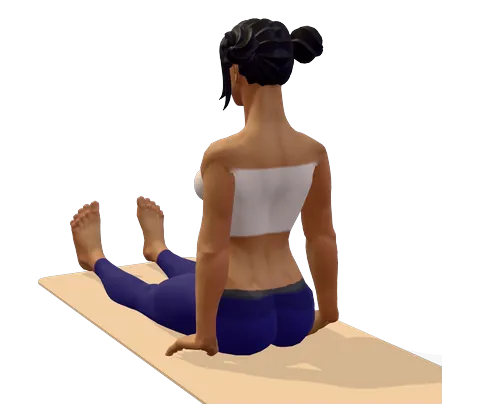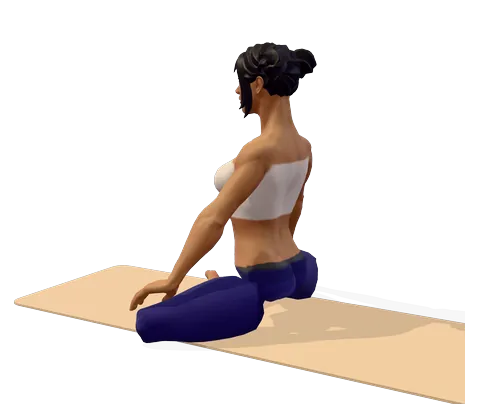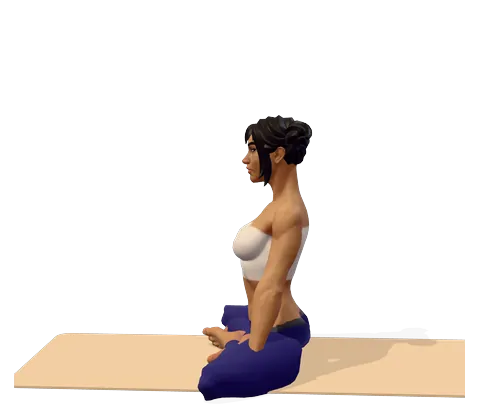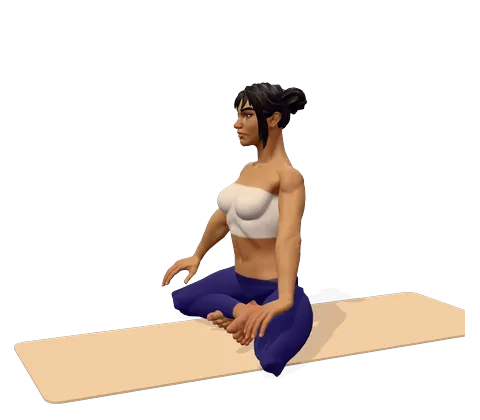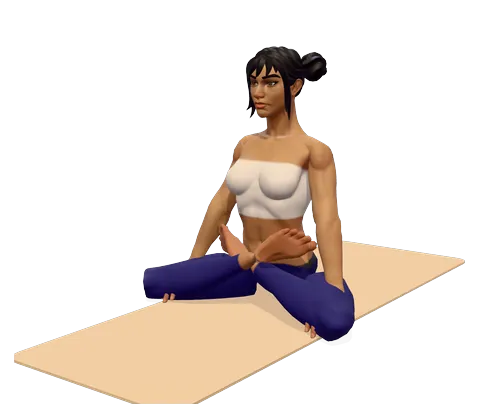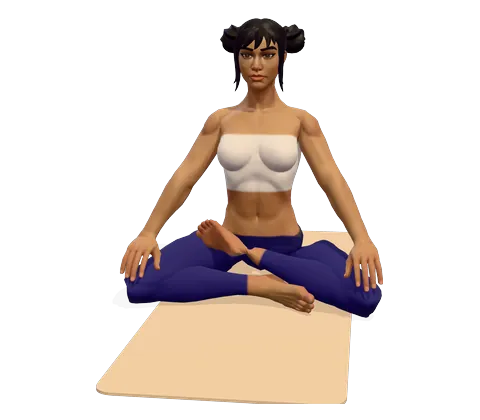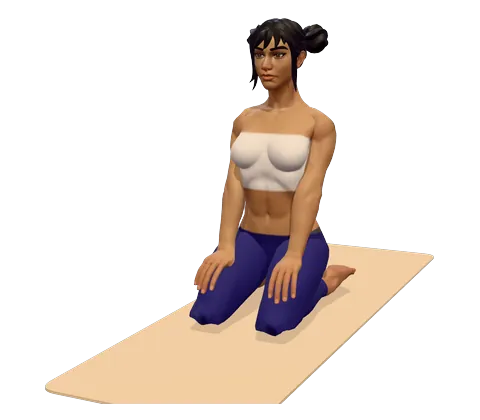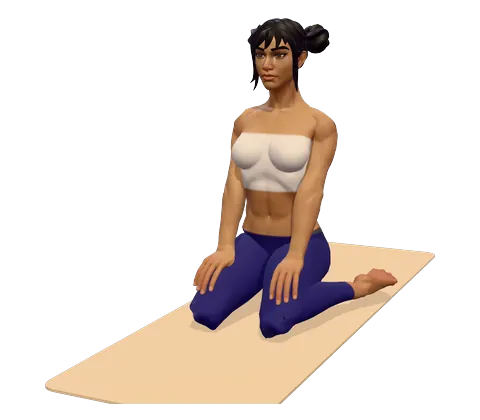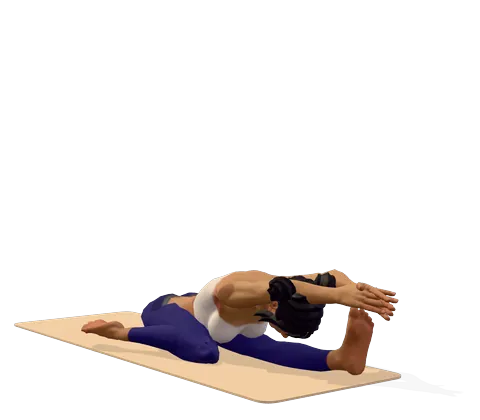
How to do Three-Limbed Forward Bend step by step
- Sit in Staff Pose with both legs straight in front of you. Place a folded blanket under your left buttock if your hips tip to one side.
- Bend your right knee and fold the right leg back so the right foot rests beside your right hip, toes pointing back and the top of the foot on the mat.
- Keep your left leg straight, toes pointing up, and draw both knees close together. Press both sitting bones evenly into the floor.
- Breathe in and lengthen your spine, lifting your arms or your chest.
- Breathe out and hinge forward from the hips over your left leg. Hold your left foot with both hands, or use a strap around the sole.
- Keep the back long, the elbows soft and the head in line with the spine, looking down toward your shin. Hold for 20–30 seconds (4–6 breaths).
- Breathe in to come up slowly, straighten the right leg and shake it out. Repeat with the left leg folded back and the right leg straight.
Where you feel Three-Limbed Forward Bend: what it stretches and strengthens
Keep both sitting bones grounded and fold over the straight leg. In the 3D guide, turn on Body guide: areas that stretch glow green and areas that work glow saffron.
Stretches
- Hamstrings
- Front thighs
- Knees
Strengthens
- Abs
Benefits and precautions
Benefits
- Stretches the hamstrings and calf of the straight leg
- Stretches the front of the thigh (quadriceps) and the front of the ankle of the folded leg
- Teaches you to fold from the hips with both sitting bones level
- Works the abdominal muscles gently as you lengthen forward
- Can calm the mind, like most slow seated forward bends
- Prepares the body for Heron Pose and other seated poses with one leg folded back
Avoid or modify if
- Knee injury, meniscus tear or knee replacement — do not fold the leg back; bend the knee to the side as in Head-to-Knee Pose instead
- Ankle stiffness or pain on the top of the foot — put a rolled towel under the ankle or skip the pose
- Slipped disc, sciatica or acute low back pain — keep the back straight, fold only a little and stop if pain spreads down the leg
- Hamstring tear — bend the straight knee slightly and fold only a short way
- Pregnancy — keep the fold very small with room for the belly and ask your midwife or doctor first
Triang Mukhaikapada Paschimottanasana is a seated forward bend in which one leg stays straight in front of you and the other is folded back beside the hip, as in Hero Pose. The English name, three-limbed forward bend, comes from the Sanskrit. It is a quieter cousin of Paschimottanasana that stretches the back of one leg and the front of the other at the same time. This page explains the name, how to do it, the muscles involved, props for beginners and who should avoid it.
Triang Mukhaikapada Paschimottanasana meaning
The long name breaks into small pieces: tri means three, anga means limb, mukha means face, eka means one, pada means foot or leg, paschima means west (the back of the body) and uttana means intense stretch. Put together: a seated forward bend in which the face moves toward one leg while three parts of the body, usually explained as the feet, the knees and the buttocks, rest on the floor. You may also see it spelled Tiriang Mukha Eka Pada Paschimottanasana. In English it is simply the three limbed forward bend or three limbed forward fold.
How to do the seated three-limbed forward bend
The steps above follow the 3D guide, which folds over the left leg first. The hardest part is not the fold. It is staying level. Because one hip sits on the floor and the other sits on a folded shin, most people roll toward the straight-leg side. These cues keep you centred:
- Prop the straight-leg side. A folded blanket under that buttock lifts it to the height of the other side. Many teachers use one for this pose every time.
- Knees together. Draw the bent knee in toward the straight one. A wide bent knee twists the pelvis.
- Folded foot points straight back. The foot should sit just outside the hip with the toes pointing behind you, not turned out. This protects the knee.
- Hinge at the hips. Lead with the chest, not the head. Stop when your lower back starts to round and hold there.
- Soft face and shoulders. The pose is a slow stretch, not a pull. Let each breath out take you a little further.
Hold for 20–30 seconds on each side at first, and up to a minute when the folded knee is comfortable.
Three-limbed forward bend benefits
The main benefit is a combined stretch that few poses give. The straight leg's hamstrings and calf lengthen as you fold, while the folded leg's quadriceps and the top of the foot stretch at the same time. Keeping both hips level also teaches you to fold from the hip joints rather than rounding the lower back, a skill that carries into every other seated forward bend.
Like other slow forward bends, it tends to feel calming, especially with long, even breaths out. It is also good preparation for Heron Pose, which uses the same folded leg with the straight leg lifted.
Muscles stretched and worked
People who ask about Paschimottanasana pose muscles worked will find the same list here, plus the front of the thigh:
| Stretched | Worked |
|---|---|
| Hamstrings and calf of the straight leg | Abdominal muscles, drawing the belly in as you lengthen forward |
| Quadriceps of the folded leg | Front thigh of the straight leg, firming to keep the kneecap lifted |
| Front of the knee and ankle of the folded leg | Muscles along the spine, keeping the back long |
With the Body guide button on, the 3D figure shows the hamstrings, quadriceps and knees glowing green and the abdominal muscles glowing saffron.
Three-limbed forward bend for beginners
- Use a strap around the sole of the straight foot and walk your hands along it. Holding the foot is not the goal.
- Sit higher. If the folded knee aches, sit on a block or a thick blanket under both hips so the knee bends less.
- Towel under the ankle of the folded leg if the top of the foot cramps.
- Bend the straight knee slightly if your hamstrings are tight, and rest your chest toward the thigh.
- Warm up first with Vajrasana for the knees and Staff Pose for the back.
Three-limbed forward bend vs similar poses
- vs Paschimottanasana: in the classic yoga seated forward bend both legs are straight. How to do Paschimottanasana well is often easier to learn after this pose, because folding one leg back shows which hamstring is tighter.
- vs Head-to-Knee Pose: in Janu Sirsasana the bent leg opens out to the side with the foot on the inner thigh. It is kinder to the knees and opens the hip instead of stretching the front thigh.
- vs standing forward bend: the standing forward bend yoga pose (Uttanasana) stretches both hamstrings with gravity doing more of the work. Standing forward bend benefits include a stronger hamstring stretch, but it is harder to control for people with back pain. In seated forward bend pose yoga, the floor supports you.
If sitting on the floor is not possible, a chair yoga forward bend (one leg straight with the heel on the floor, folding over it from the chair) gives a similar hamstring stretch; see chair yoga.
Forward bends and lower back pain
Back pain with bending forward is common, and people often wonder whether yoga forward bend poses help or hurt. It depends on the cause. If you have low back pain when bending forward, a disc problem is one possible reason, and deep folds can make it worse. If your lower back pain can't bend forward because of stiffness, a gentle hip-hinge fold with a flat back may ease it over time. Some people with other conditions, such as spinal stenosis, find their back pain relieved by bending forward, and that kind of lower back pain relief when bending forward is a clue worth telling your doctor.
Because you cannot tell these apart by yourself, get the cause checked first and follow your physiotherapist's advice. If your lower back pain is worse when bending forward, keep this pose to a small, flat-backed hinge. After back surgery, the usual bend, lift and twist precautions apply to yoga as well. For gentler options see yoga for back pain.
Precautions
The folded knee takes the most load. If you feel a sharp pain inside the knee, come out at once and switch to Head-to-Knee Pose. Do not push the folded foot out to the side to make room. People with low blood pressure should come up slowly. You can add the pose to your own sequence in the sequence builder.
Frequently asked questions
What does Triang Mukhaikapada Paschimottanasana mean?
It means a seated forward bend (paschimottanasana) with the face (mukha) toward one leg (eka pada), with three limbs (tri anga) grounded. In English it is called the three-limbed forward bend.
What are the benefits of the three-limbed forward bend?
It stretches the hamstrings and calf of the straight leg and the front thigh and ankle of the folded leg, teaches you to fold from the hips, and can feel calming.
Why do I tip over to one side?
The folded leg lifts one hip. Put a folded blanket under the buttock of the straight-leg side so both sitting bones are level.
Is it safe for bad knees?
Often not. The folded knee bends fully. If you have a knee injury or knee replacement, choose Head-to-Knee Pose instead, or sit on a high block and ask your physiotherapist.
How long should I hold it?
Start with 20–30 seconds on each side and build up to a minute if the knee and ankle are comfortable.
What is the difference between this pose and Janu Sirsasana?
In Janu Sirsasana the bent leg opens out to the side with the foot on the inner thigh. In the three-limbed forward bend the bent leg folds back beside the hip.
This page is for general education. Check with your doctor before starting yoga if you are pregnant, have a medical condition or an injury. Stop if you feel pain, dizziness or shortness of breath.