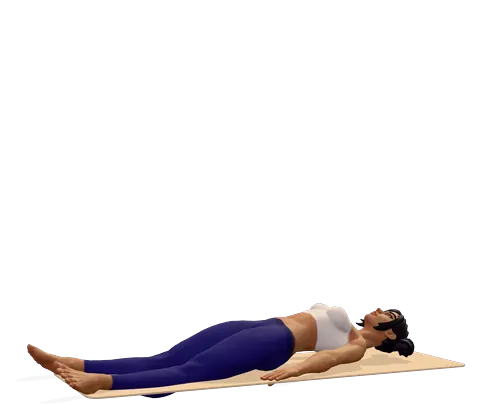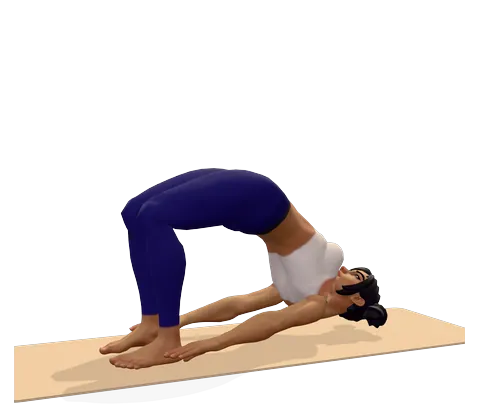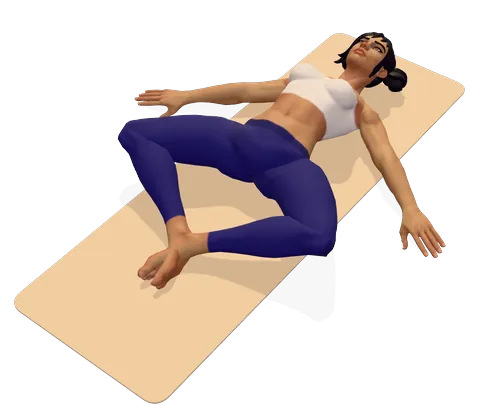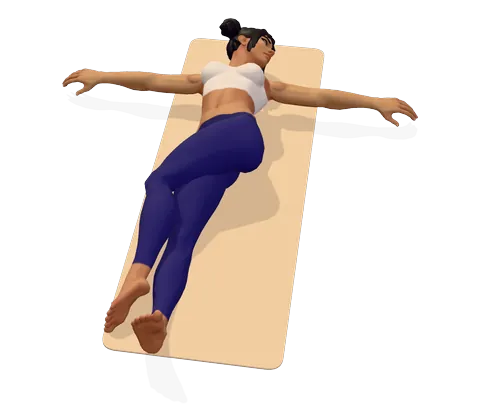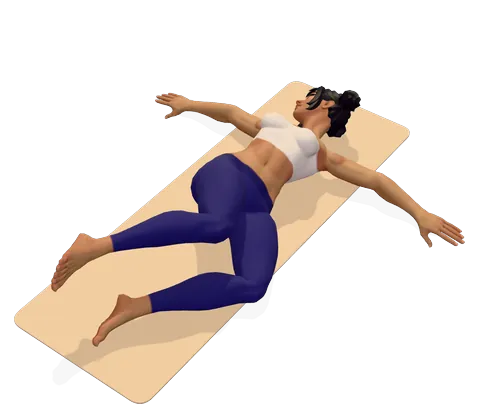
How to do Monkey Twist Pose step by step
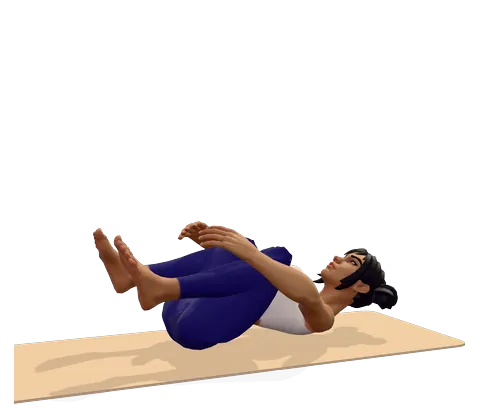
- Lie on your back with your knees bent and your feet flat on the mat, feet and knees together, close to your hips.
- Stretch your arms out to the sides at shoulder height, palms facing down, so your body makes a T shape.
- Breathe out and slowly lower both knees to the left toward the floor. Let them rest on the mat or on a cushion.
- At the same time turn your head to the right and look along your right arm. Keep both shoulders heavy on the mat.
- Stay for 4–6 slow breaths (about 30 seconds). With each breath out, let your lower back and hips soften a little more.
- Breathe in and bring your knees and head back to the centre, using your belly muscles.
- Repeat on the other side: knees to the right, head to the left. Finish by hugging your knees to your chest.
Where you feel Monkey Twist Pose: what it stretches and strengthens
Drop your knees one way and turn your head the other. In the 3D guide, turn on Body guide: areas that stretch glow green and areas that work glow saffron.
Stretches
- Side waist
- Lower back
- Glutes
Benefits and precautions
Benefits
- Gently rotates the whole spine and eases stiffness in the lower and middle back
- Stretches the side waist (obliques), the outer hips and the chest
- Relaxes the back muscles after sitting, standing or a hard workout
- Traditionally used to aid digestion and relieve a bloated feeling
- Calms the nervous system when done slowly with long breaths out; a good pose before bed
- Easy enough for beginners, seniors and children
Avoid or modify if
- Pregnancy after the first trimester — avoid lying flat on your back for long; practise a seated gentle twist instead
- Recent back surgery, an acute disc injury or sacroiliac joint pain — only with your physiotherapist's approval
- Recent abdominal surgery or a hernia — skip twists until your doctor clears you
- Hip replacement — keep the knees apart and the twist small, and follow your surgeon's movement rules
- Neck pain — keep your head in the centre instead of turning it
Markatasana (monkey twist pose) is a gentle lying twist in which you drop your bent knees to one side and turn your head the other way. It is one of the easiest twists in yoga, so it suits beginners, seniors and anyone with a stiff back after a long day. Many teachers use it at the end of a class or before bed. This page explains what the name means, how to do it, its benefits, variations and who should be careful.
What is monkey pose in yoga?
In Sanskrit, markata means "monkey" and asana means "pose", so Markatasana in English is "monkey pose". The name comes from the way the body and head turn in opposite directions, like a monkey twisting playfully to look behind it. You may see it called the monkey twist yoga pose, the twisted or crooked monkey yoga pose or, in fitness classes, a knee drop twist or lying knee twist exercise. Yoga teachers also group it with the supine twist family (a lying spinal twist).
Do not confuse it with other "monkey" poses. Half monkey pose in yoga (Ardha Hanumanasana) is a kneeling hamstring stretch and full monkey pose (Hanumanasana) is the front splits, named after Hanuman. Markatasana is a twist done lying on your back.
How to do Markatasana (Markatasana kaise kare)
The monkey twist pose steps above show the basic version that the 3D guide demonstrates: knees together and bent, dropping to the left while the head turns right. These tips help:
- Shoulders stay down. The twist should come from your waist and ribs. If your opposite shoulder lifts off the mat, do not push the knees lower.
- Knees stay together. Keep them stacked so the rotation is even through the lower back.
- Move with the breath. Breathe out as the knees go down and breathe in as they return. Never force the knees to the floor.
- Soft neck. Turn the head only as far as feels easy. The chin stays level, not lifted.
You should feel a mild stretch across the side of your waist, the outer hip and perhaps the chest. The lower back should feel released, not squeezed.
Markatasana variations
In many Indian yoga schools Markatasana is taught in three stages:
- Knees together (the basic lying knee twist): as shown in the 3D demo.
- Feet wide apart: place your feet wider than the mat. As the knees drop left, the right knee moves toward the left heel. This gives a deeper twist in the lower back.
- One foot on the other knee: with the legs straight, place one heel on the toes or knee of the other leg and drop the legs sideways.
For Markatasana for beginners or stiff backs, place a cushion or folded blanket under the knees so they do not hang in the air. For an easy twist yoga pose on a chair, sit tall and turn your chest toward the chair back; a standing option is a chair pose with twist, which is much stronger.
Markatasana benefits
The benefits of yoga twist poses come from moving the spine in rotation, a direction we rarely use in daily life. The main monkey twist pose benefits are:
- Back stiffness. The slow, supported rotation mobilises the lower and middle back. Using Markatasana for back pain is common: gentle twists are among the asanas for back pain relief in many beginner programmes, and a reclining twist for back pain is easy to control. See our yoga for back pain plan.
- Digestion. Yoga teachers traditionally recommend Markatasana for digestion, saying the twist massages the abdomen. Many people find it eases a bloated feeling, which is why it appears in routines for gas and bloating and constipation.
- Rest and sleep. Markatasana for sleep works because lying down with long breaths out tells the body it is safe to relax. Try it in a bedtime routine from our yoga for sleep page.
- Hips and chest. The outer hip and the chest open, helpful after long periods of sitting.
Muscles stretched
The obliques and other side waist muscles, the small muscles along the lower back, the glutes and outer hip of the top leg, and the chest on the side opposite the knees. Press the Body guide button on the 3D demo to see these areas glow green.
Markatasana vs Makarasana and other twists
The names look alike, so people often mix them up. Makarasana, the crocodile pose, is a relaxation pose lying on your front, forehead on your folded arms; its benefits are rest and easy belly breathing. Markatasana is a lying twist on your back. So in Markatasana vs Makarasana, choose the first to move the spine and the second (a Makarasana yoga pose for resting between back exercises) to relax.
| Pose | Position | How it differs |
|---|---|---|
| Markatasana | On your back, knees bent | Knees and head turn opposite ways; very gentle |
| Supta Matsyendrasana | On your back, one knee crossed | A reclined spinal twist yoga pose with one leg straight; a little deeper |
| Ardha Matsyendrasana | Seated | A seated spinal twist pose; you hold yourself up, so it is more active |
| Makarasana | On your front | No twist; a resting pose |
Markatasana contraindications
This is a safe pose for most people, but read the Markatasana precautions in the caution box above. Twists put a small rotational load on the discs of the lower back, so after an acute disc injury or back surgery, ask your physiotherapist first. In later pregnancy, a seated gentle twist that turns away from the belly is safer than lying on your back. If any twist causes sharp pain or pain down the leg, stop.
Preparation and when to practise
Good Markatasana prep is simply hugging the knees to your chest and rocking side to side, or a few rounds of wind-relieving pose. Hold each side for about 30 seconds and repeat once or twice. It works well after backbends and forward bends, at the end of a session before corpse pose, or in bed at night. You can add it to your own routine with the sequence builder. Yoga karne ke fayde build up with regular short practice, so a few minutes daily beats one long session a week.
Monkey yoga pose for kids
Markatasana for kids is easy to teach: children enjoy it as a "monkey looking over its shoulder". Keep it playful and short, and let them swing the knees slowly from side to side with the breath.
मर्कटासन (Markatasana in Hindi): पीठ के बल लेटें, घुटने मोड़ें और बाँहें कंधों की सीध में फैलाएँ। साँस छोड़ते हुए दोनों घुटने बाईं ओर ज़मीन की तरफ़ ले जाएँ और सिर दाईं ओर घुमाएँ। 30 सेकंड रुकें, फिर दूसरी तरफ़ करें। मर्कटासन के फायदे (Markatasana ke fayde): कमर की अकड़न कम होती है, पेट हल्का महसूस होता है और मन शांत होता है। कमर या पेट की सर्जरी के बाद पहले डॉक्टर से पूछें।
Frequently asked questions
What is Markatasana and what is its meaning?
Markatasana meaning: markata is Sanskrit for monkey, so it is the monkey twist pose, a gentle lying twist. You lie on your back with bent knees, drop the knees to one side and turn your head the other way, like a monkey looking back.
What are the benefits of Markatasana?
It eases back stiffness, stretches the side waist and outer hips, may help digestion and a bloated feeling, and relaxes the body before sleep.
How long should I hold monkey twist pose?
About 30 seconds, or 4–6 slow breaths, on each side. You can repeat each side once or twice.
Is Markatasana good for back pain?
A gentle twist like this often feels good for everyday back stiffness. With a disc injury, sciatica or after back surgery, ask your physiotherapist first and stop if pain spreads down the leg.
What is the difference between Markatasana and Makarasana?
Markatasana is a twist lying on your back. Makarasana (crocodile pose) is a relaxation pose lying on your front with your head on your folded arms.
Can I do Markatasana during pregnancy?
In the first trimester a very gentle version may be fine with your doctor's approval. Later on, avoid lying flat on your back and choose a seated twist that turns away from the belly.
Markatasana vs Supta Matsyendrasana: which is easier?
Markatasana is easier because both knees stay together and bent. Supta Matsyendrasana crosses one bent knee over a straight leg, which twists the lower back a little more.
Can I do monkey twist pose in bed?
Yes. On a firm mattress it is a simple way to release your back before sleep. Move slowly and keep the twist small.
This page is for general education. Check with your doctor before starting yoga if you are pregnant, have a medical condition or an injury. Stop if you feel pain, dizziness or shortness of breath.