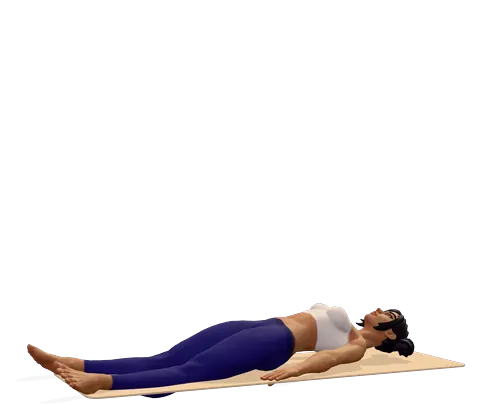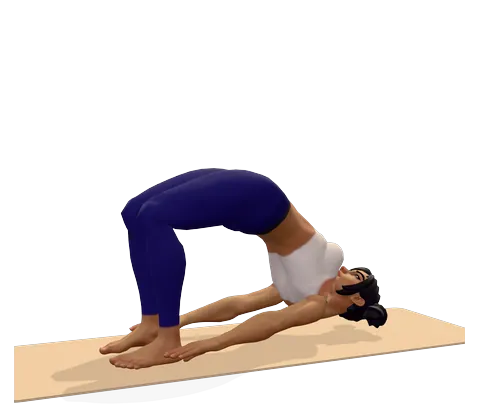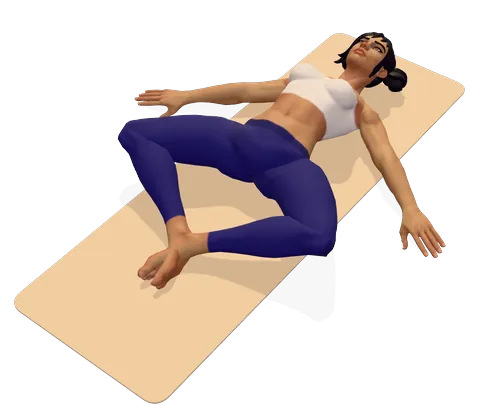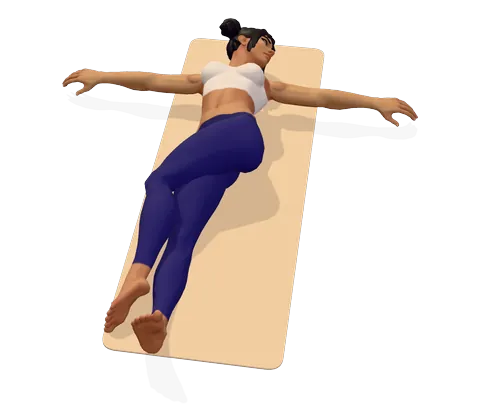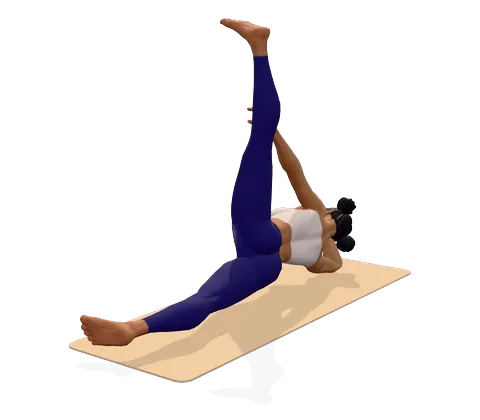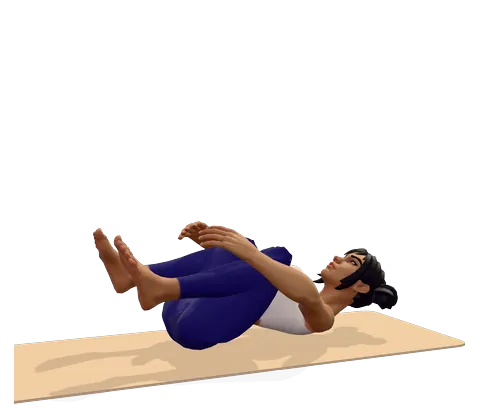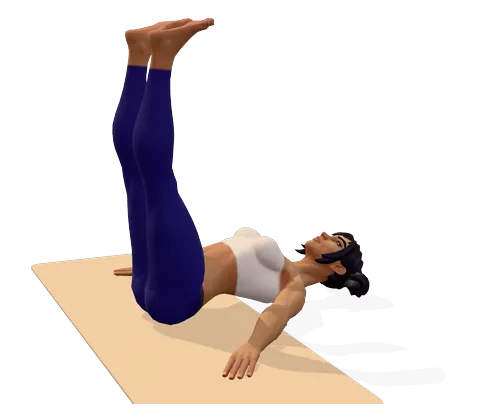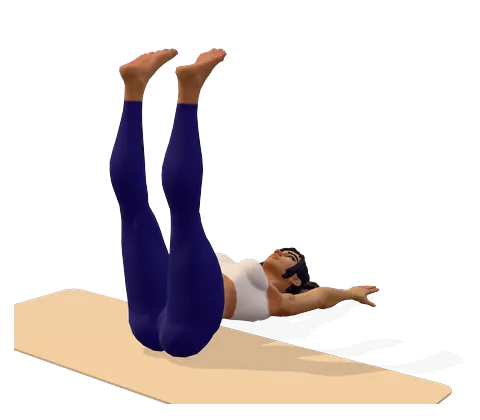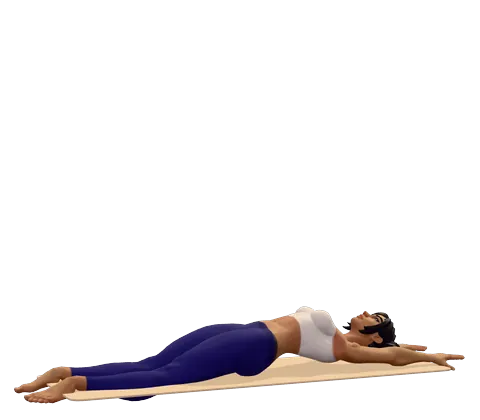
How to do Stick Pose step by step
- Lie on your back with your legs straight and together and your arms by your sides.
- Breathing in, sweep your arms up and over your head and rest them on the floor behind you, shoulder-width apart.
- Stretch your fingers away from you and point your toes, so your body lengthens in two directions.
- Keep your lower ribs soft and your lower back resting on the mat. Do not let the back arch up.
- Hold the stretch for about 30 seconds with slow, full breaths, feeling the belly and sides lengthen.
- Breathing out, release the stretch, bring your arms back to your sides and rest for a few breaths in Savasana.
Where you feel Stick Pose: what it stretches and strengthens
Reach your arms and feet in opposite directions and lengthen. In the 3D guide, turn on Body guide: areas that stretch glow green and areas that work glow saffron.
Stretches
- Abs
- Shoulders
- Spine
Benefits and precautions
Benefits
- Stretches the whole body at once: shoulders, sides, abdomen and spine
- Gently lengthens the abdomen and the muscles between the ribs, which can make breathing feel fuller
- Wakes the body up in the morning without effort — a good first stretch in bed or on the mat
- Teaches the long, straight alignment of mountain pose while lying down
- Relieves stiffness after sitting and can ease the back when done gently
- Easy and safe for most beginners, seniors and children
Avoid or modify if
- Shoulder injury or frozen shoulder — take the arms only as far overhead as is comfortable, or keep them by your sides
- Lower back pain when the legs are straight — bend your knees and keep your feet on the floor
- Later pregnancy — avoid lying flat on your back for long; do it seated or standing instead
- Leg cramps when pointing the toes — flex the feet and push through the heels instead
Stick pose (Yastikasana) is a lying-down stretch in which you reach your arms over your head and lengthen the whole body from fingertips to toes, like a straight stick. It is also called Supta Tadasana or reclining mountain pose, because it is mountain pose done on your back. It takes a few seconds to learn, suits every age and is a gentle way to start or end a practice. This page explains how to do stick pose yoga, its benefits, easy variations and a few precautions.
What is Yastikasana?
The name comes from Sanskrit: yashti (also spelled yasti) means "stick" or "staff", and asana means "pose". That is why you will see it written as Yastikasana or Yashtikasana. The body lies straight and long, and the stretch runs in two directions at once — arms one way, legs the other.
Other names: Supta Tadasana and reclining mountain pose
Many teachers call it Supta Tadasana ("reclining mountain pose") or Supta Utthita Tadasana ("reclining extended mountain pose"). It is the stick pose of Tadasana: the same alignment as standing mountain pose with the arms raised, but lying down, so there is no balance to manage.
How to do stick pose (Yastikasana kaise kare)
Follow the steps above with the 3D figure. These points make the stretch work:
- Reach, don't arch: when the arms go overhead, the lower ribs tend to pop up and the back arches. Keep the ribs soft and the lower back close to the mat.
- Two directions: feel the fingers go one way and the toes the other. The middle of the body should feel long, not tense.
- Use the breath: stretch a little more as you breathe in, then soften as you breathe out.
- What you should feel: a pleasant lengthening of the shoulders, sides, belly and spine. Nothing should pinch in the shoulders or lower back.
Hold for about 30 seconds. You can repeat it 2–3 times: stretch on the breath in, relax on the breath out.
Benefits of stick pose
The benefits of stick pose are simple and practical. It stretches the whole body at once, gently lengthens the abdomen and the muscles between the ribs, and helps release stiffness from sitting or sleeping. Stick pose yoga benefits are especially useful first thing in the morning: many people do it in bed before getting up. It also teaches the straight, even alignment of mountain pose, which carries into standing and sitting posture.
As with the benefits of yoga poses in general, these effects build over time with regular, gentle practice, not a single long hold.
Muscles stretched
Stick pose mostly stretches the abdominals, the shoulders and the muscles along the spine. Turn on the Body guide in the 3D viewer to see these areas glow green.
Stick pose vs Dandasana, mountain pose and balancing stick
The word "stick" appears in several yoga stick poses, which causes confusion:
| Pose | Position | Main work |
|---|---|---|
| Yastikasana (stick pose) | Lying on the back, arms overhead | Whole-body stretch; relaxation |
| Dandasana (staff pose) | Sitting, legs straight forward | Upright back and core; base for seated poses |
| Tadasana (mountain pose) | Standing | Posture and balance |
| Balancing stick (Tuladandasana) | Standing on one leg, body and arms level | Strength and balance; advanced |
When people say "stick pose Dandasana", they mean staff pose: danda also means "stick". The benefits of Dandasana are about a strong, upright back, while Yastikasana is about length and rest. Balancing stick pose benefits include leg strength and balance, but it is a hard pose, not a beginner stretch.
Tadasana and stick pose
What is Tadasana yoga? In short, the Tadasana information in English is this: it is standing mountain pose: feet together, weight even, spine long, arms by the sides or raised. How to do Tadasana (or how to perform Tadasana) is covered step by step on the mountain pose page. Stick pose is a useful way to learn it, because the floor shows you when your back arches or your shoulders hunch. The benefits of mountain pose — better posture, balance and body awareness — start here.
Simple Tadasana exercises for beginners
These Tadasana exercises for beginners combine the standing and lying versions:
- For breathing: in stick pose, breathe in as you reach and out as you relax. These Tadasana exercises for breathing make the sides of the ribs move more.
- For posture: stand in Tadasana against a wall, heels, buttocks and shoulders touching it. These Tadasana exercises for posture teach the upright line, and Tadasana benefits for posture come from feeling it.
- For balance: rise onto the toes with the arms up, as in palm tree pose. These Tadasana exercises for balance also bring Tadasana benefits for core strength. The benefits of tree pose (Vrikshasana) are the next step.
- For the spine and back: gentle Tadasana exercises for back pain, such as reaching up and swaying slowly side to side, give the spine a light stretch; Tadasana benefits for spine health come from regular practice.
- For relaxation: finish with stick pose, then Savasana. Tadasana exercises for relaxation are a good way to end the day.
Is stick pose a good yoga pose for back pain?
A gentle full-body stretch is often part of beginner yoga poses for back pain and yoga poses for back pain relief, and stick pose is easy to fit in. As a yoga pose for lower back pain, keep the lower back on the mat; if it aches with the legs straight, bend your knees. Follow it with a gentle spinal twist such as Supta Matsyendrasana (supine spinal twist); the benefits of yoga twist poses include a gentle release for the back muscles. In India, Tadasana is also listed among the asanas for back pain in the Class 12 physical education syllabus. For a full plan of poses for yoga for back pain, see yoga for back pain. If getting to the floor is difficult, chair yoga poses for back pain include a seated version: sit tall and reach the arms up.
Stick pose yoga for kids and seniors
Stick pose yoga for kids is often taught as "be a long pencil" or "stretch like a stick" and can end with rolling along the mat. For seniors, it is a safe morning stretch in bed. Take the arms only as high as the shoulders allow. See yoga for seniors and yoga for kids.
यष्टिकासन (Yastikasana) — हिंदी में: पीठ के बल सीधे लेटें, पैर आपस में मिले हों। साँस लेते हुए दोनों हाथ सिर के ऊपर ले जाकर ज़मीन पर रखें। हाथों की उँगलियों को ऊपर की ओर और पैरों के पंजों को नीचे की ओर खींचें, पूरा शरीर लंबा करें। लगभग 30 सेकंड रुकें और साँस छोड़ते हुए ढीले हो जाएँ। इस योग के फायदे: पूरे शरीर में खिंचाव, रीढ़ और पेट को आराम, और सुबह की अकड़न कम होती है।
Frequently asked questions
What is stick pose in yoga?
Stick pose (Yastikasana) is a lying stretch: you lie on your back, reach your arms overhead and lengthen from fingers to toes. It is also called Supta Tadasana or reclining mountain pose.
What are the benefits of stick pose?
It stretches the shoulders, sides, abdomen and spine at once, eases stiffness from sitting or sleeping and teaches the straight alignment of mountain pose. It is gentle enough for most people.
Is stick pose the same as Dandasana?
No. Dandasana (staff pose) is seated with the legs straight forward. Yastikasana is done lying on the back with the arms overhead. Both names come from words meaning stick.
How long should I hold Yastikasana?
About 30 seconds. You can repeat it 2–3 times, stretching on the breath in and relaxing on the breath out.
Can I do stick pose in bed?
Yes. It is a good first stretch in the morning. A firm mattress works best.
Yastikasana yoga ke fayde in Hindi?
It gives a full-body stretch, relaxes the spine and belly, and reduces morning stiffness. See the Hindi box above for simple steps.
This page is for general education. Check with your doctor before starting yoga if you are pregnant, have a medical condition or an injury. Stop if you feel pain, dizziness or shortness of breath.