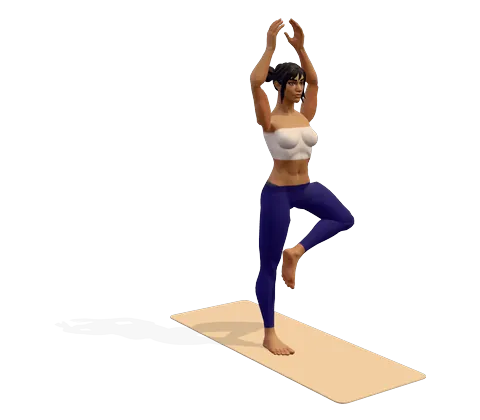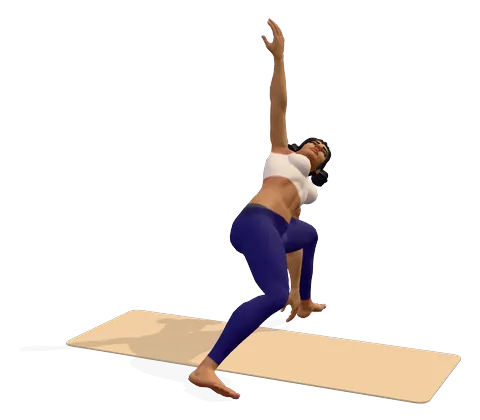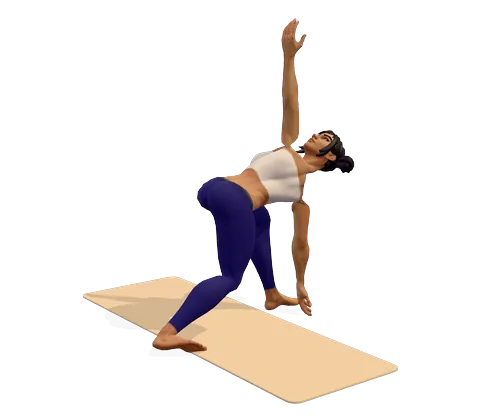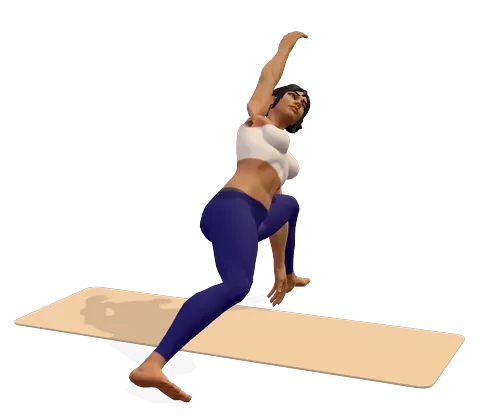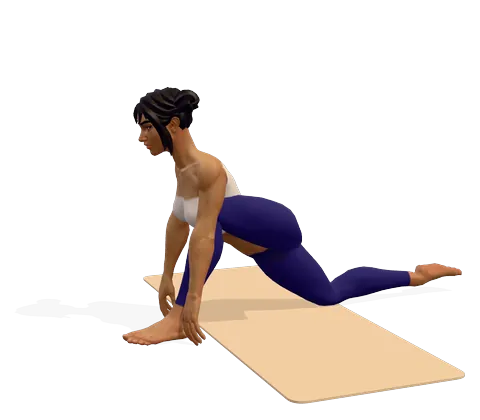
How to do Equestrian Pose step by step
- Start in a standing forward bend with your hands on the mat beside your feet. Bend your knees as much as you need so your palms rest flat.
- Keeping your hands in place, step your right foot far back. Your left foot stays between your hands, the left knee over the left ankle.
- Rest the right knee on the mat with the top of the foot down, or keep the knee lifted on the toes for a stronger version.
- Press your fingertips or palms into the floor beside the front foot and lift your chest forward and up. Let your hips sink gently toward the floor.
- Look forward or slightly up, keeping the back of the neck long. Shoulders move away from the ears.
- Hold for 3–5 breaths (about 20 seconds) on its own, or for one inhale in Surya Namaskar.
- To come out, step the right foot forward to meet the left and fold into a standing forward bend, or step the left foot back into plank. Repeat with the right foot forward.
Where you feel Equestrian Pose: what it stretches and strengthens
Press the back heel away and let the front hip sink. In the 3D guide, turn on Body guide: areas that stretch glow green and areas that work glow saffron.
Stretches
- Hip flexors
- Hamstrings
Strengthens
- Front thighs
- Glutes
Benefits and precautions
Benefits
- Stretches the hip flexors and front of the thigh of the back leg
- Strengthens the front leg, buttocks and ankles
- Opens the chest and lengthens the front of the body
- Improves hip mobility for walking, running and sitting on the floor
- Links the standing and floor poses of Surya Namaskar, warming the whole body
- Builds focus and balance in a low, stable position
Avoid or modify if
- Knee injury or pain — pad the back knee with a blanket and do not let the front knee pass the toes
- Recent hip or groin strain — keep the lunge short and the hips higher
- Lower back pain that worsens when you arch — keep the chest more level and the gaze down
- Neck problems — look at the floor ahead rather than up
- Pregnancy — step the front foot a little wider and use blocks under the hands; ask your doctor or midwife
Equestrian pose (Ashwa Sanchalanasana) is a deep lunge with the hands on the floor, the back leg stretched long and the chest lifted — the shape of a rider leaning forward on a horse. It is best known as steps 4 and 9 of Surya Namaskar, but it is also a useful hip stretch on its own. Here is how to do equestrian pose, what it is good for, how it differs from low lunge, and how to adapt it.
What is equestrian pose in yoga?
The Sanskrit name has three parts: ashwa means "horse", sanchalana means "movement" or "riding", and asana means "pose". So the Ashwa Sanchalanasana meaning is "horse-riding pose", and in English it is called equestrian pose or simply a lunge pose. In Hindi, Ashwa Sanchalanasana is written अश्व संचालनासन.
Equestrian pose pronunciation in Sanskrit: ASH-wah sun-CHAH-lah-NAHS-uh-nuh. Other names for equestrian pose are horse riding pose and lunge pose. In the asana categories it counts as a lunge — a standing pose done close to the floor.
Horse riding pose, horse pose and horse stance
Several poses are named after horses, which causes confusion. In yoga, horse riding pose means Ashwa Sanchalanasana, the lunge from Surya Namaskar. "Horse stance" or horse pose, from martial arts and many yoga classes, is a wide squat with bent knees — see goddess pose. They share a name but work the body quite differently.
Equestrian pose in Surya Namaskar
In the classic 12-step Sun Salutation, equestrian pose appears twice. In step 4 you step one leg back from the standing forward bend (Padahastasana) on an inhale. In step 9 you step the same foot forward again from downward dog, also on an inhale. On the next round, you change legs. The breath matters: you breathe in as the chest lifts, which is why the pose feels opening rather than heavy.
Benefits of Ashwa Sanchalanasana in Surya Namaskar go beyond the stretch itself: the lunge links the standing and floor halves of the sequence, so the heart rate rises gently and the legs warm up. You can follow the full sequence, counted and voiced, in the Surya Namaskar session of the guided sessions.
How to do equestrian pose correctly
The steps above show how to do Ashwa Sanchalanasana step by step. These details make the difference:
- Step far enough back. A short step puts the front knee far past the toes and strains it. Aim for the knee directly above the ankle.
- Fingertips can "tent". If your palms don't reach the floor comfortably, come onto your fingertips or use blocks. This lets the chest lift.
- Chest forward, not just up. Imagine the breastbone moving toward the wall in front, so the spine lengthens rather than crunching the lower back.
- Soft gaze. Look slightly up only if your neck is happy; otherwise gaze at the floor a little in front of you.
- Relax the hips down. Let gravity do the stretching. Don't bounce.
Equestrian pose benefits (Ashwa Sanchalanasana ke fayde)
What is the primary benefit of Ashwa Sanchalanasana? The main physical benefit is a stretch of the hip flexors and the front of the thigh on the back leg, muscles that stay short when we sit for long hours. Like any lunge pose, its benefits start with the legs. Other benefits of equestrian pose in yoga:
- Stronger legs: the front thigh and buttock hold your weight, and the ankles work to steady you.
- Open chest: lifting the chest and drawing the shoulders back counters slouching and lets the breath move freely.
- Hip mobility: regular lunges help keep the hips moving well, which is why lunges appear in our yoga for tight hips plan.
- Traditional view: yoga texts say the front thigh presses on the belly and tones the digestive organs. This is a traditional idea rather than a proven effect.
Equestrian pose vs low lunge (Ashwa Sanchalanasana vs Anjaneyasana)
Ashwa Sanchalanasana and Anjaneyasana are close cousins. In equestrian pose the hands stay on the floor, the chest leans forward and the gaze is forward. In low lunge (Anjaneyasana) the back knee is down, the torso is upright and the arms reach overhead, so the hip-flexor stretch is deeper and the chest opens more. Many teachers use equestrian pose as the first stage of low lunge: from here, simply lift your hands to the front thigh and then overhead.
Equestrian pose variations and modifications
- Back knee down: the easiest Ashwa Sanchalanasana modification, good for beginners and anyone with weak legs. Pad the knee.
- Back knee lifted: press through the back heel for more strength and heat.
- Hands on blocks: helpful if your hamstrings or back are stiff, and in pregnancy.
- Utthita Ashwa Sanchalanasana (extended equestrian pose): from the lunge, lift the chest upright and bring the palms together at the heart or reach the arms up, with the back knee lifted. Utthita Ashwa Sanchalanasana benefits: more leg strength, balance and chest opening.
- Chair version: sit sideways on a chair and extend one leg back — a gentle option for seniors.
If you are new, start with the knee-down variation and read our yoga for beginners guide for how often to practise.
Ashwa Sanchalanasana precautions and contraindications
Equestrian pose is gentle for most people. The main precautions involve the knees, hips and lower back — see the caution box above. If you feel a pinch in the front of the hip, shorten the lunge and lift the hips slightly. If the back knee hurts on a hard floor, fold a blanket under it. Stop if pain is sharp rather than a stretch.
अश्व संचालनासन (Ashwa Sanchalanasana) — हिंदी में: आगे झुककर हथेलियाँ पैरों के पास ज़मीन पर रखें। दायाँ पैर पीछे ले जाएँ और बायाँ घुटना टखने के ऊपर रखें। छाती ऊपर उठाएँ और सामने या थोड़ा ऊपर देखें। 3–5 साँस रुकें, फिर दूसरी ओर करें। अश्व संचालनासन के फायदे: कूल्हे और जाँघ की मांसपेशियाँ खिंचती हैं, पैर मज़बूत होते हैं और यह सूर्य नमस्कार का ज़रूरी हिस्सा है।
Frequently asked questions
What is Ashwa Sanchalanasana and its benefits?
Ashwa Sanchalanasana (equestrian pose) is a deep lunge with the hands on the floor and the chest lifted. It stretches the hip flexors, strengthens the legs, opens the chest and is steps 4 and 9 of Surya Namaskar.
What is the meaning of equestrian pose in Hindi?
In Hindi it is अश्व संचालनासन: ashwa means horse and sanchalana means riding or movement, so it is the "horse-riding pose".
Is equestrian pose the same as low lunge?
They are very similar. Equestrian pose keeps the hands on the floor and the chest leaning forward; low lunge (Anjaneyasana) lifts the torso upright with the arms overhead.
Should the back knee be on the floor in equestrian pose?
Either is fine. Resting the knee is easier and is common in Hatha Surya Namaskar; lifting it builds more leg strength.
How long should I hold equestrian pose?
In Surya Namaskar you hold it for one breath in. On its own, hold 3–5 breaths (about 20 seconds) on each side.
Who should avoid Ashwa Sanchalanasana?
People with an acute knee, hip or groin injury, and anyone whose lower back or neck hurts when lifting the chest, should modify it or skip it. In pregnancy, use a wider stance and blocks with your doctor’s OK.
What is horse pose in yoga?
The name is used for different poses. The horse riding pose is equestrian pose (Ashwa Sanchalanasana). Horse stance is a wide squat, similar to goddess pose.
This page is for general education. Check with your doctor before starting yoga if you are pregnant, have a medical condition or an injury. Stop if you feel pain, dizziness or shortness of breath.