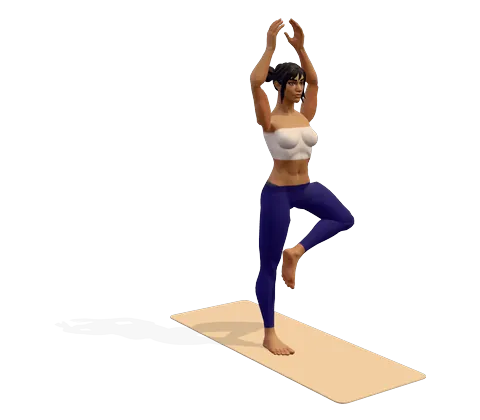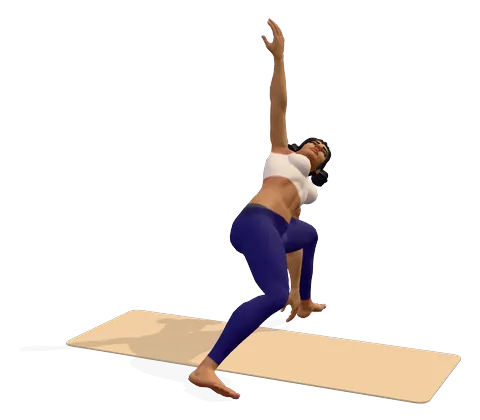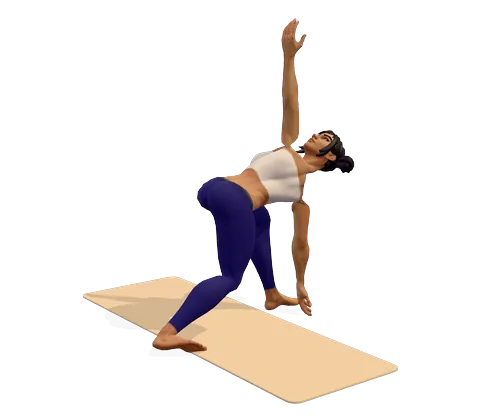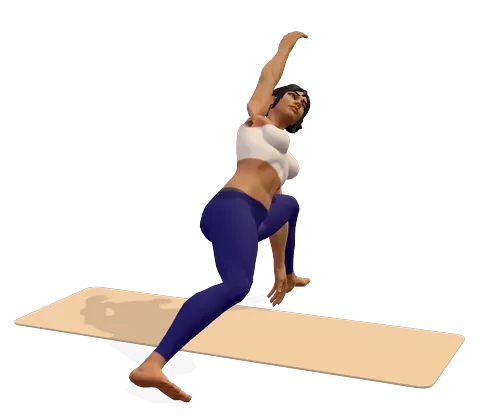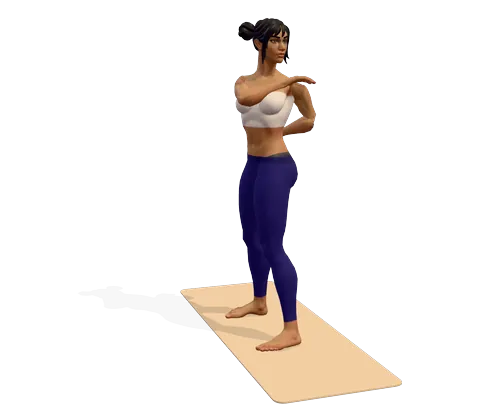
How to do Standing Spinal Twist step by step
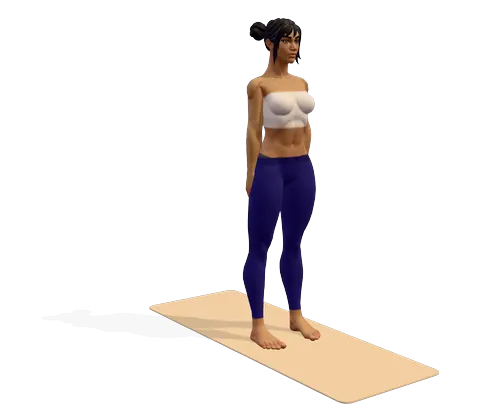
- Stand with your feet a little wider than your shoulders, toes turned slightly out, arms relaxed by your sides.
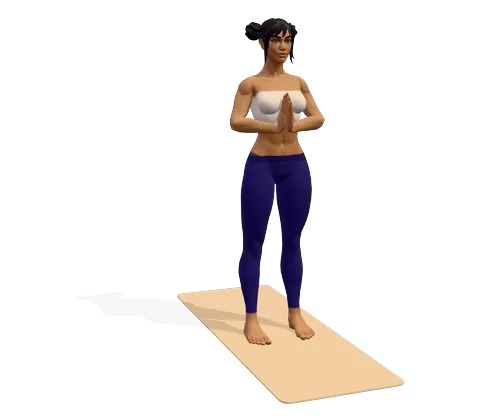
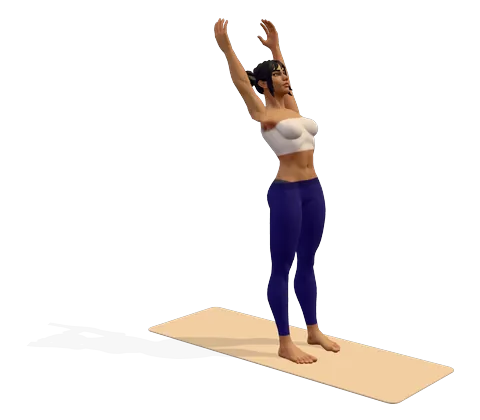
- Breathing in, raise your arms in front of you to shoulder height, or simply lengthen your spine.
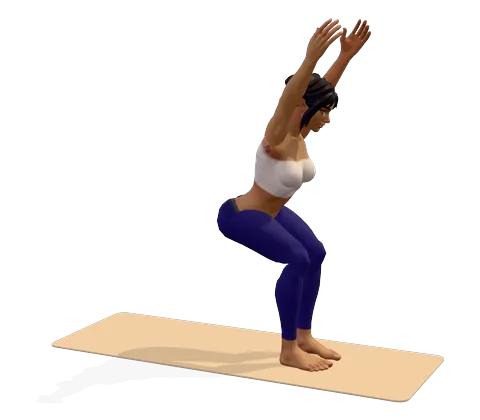
- Breathing out, turn your upper body to the left, starting from the waist. Keep your feet flat and your knees soft.
- Let your right hand wrap onto your left shoulder and your left arm wrap behind your back, the back of the hand resting on your waist.
- Turn your head and look back over your left shoulder, without straining the neck. Hold for 2–3 breaths.
- Breathing in, unwind slowly back to the centre.
- Breathing out, twist to the right with the arms reversed. Do 5–10 slow rounds; you can also let the arms swing loosely in a relaxed rhythm.
Where you feel Standing Spinal Twist: what it stretches and strengthens
Keep your feet planted and let your arms swing loosely as you turn. In the 3D guide, turn on Body guide: areas that stretch glow green and areas that work glow saffron.
Stretches
- Side waist
- Spine
- Shoulders
Strengthens
- Abs
Benefits and precautions
Benefits
- Gently rotates the spine and eases stiffness in the back
- Stretches the obliques and the muscles around the waist
- Loosens the shoulders and upper back
- Works the abdominal muscles that turn the trunk
- A quick, easy break from sitting that wakes up the body
- Traditionally used to support digestion and relaxation
Avoid or modify if
- Slipped disc, spondylolisthesis or acute back pain — twist only a little, slowly, or skip it; ask your physiotherapist
- After spinal surgery with "no bending, lifting or twisting" precautions — do not twist until your surgeon clears you
- Pregnancy — only a very small twist from the upper back, never a deep twist; ask your midwife or doctor
- Recent abdominal surgery or a hernia — avoid until your doctor says it is safe
- Vertigo or neck pain — keep your head facing forward and move slowly
Kati Chakrasana, the standing spinal twist, is one of the simplest twists in yoga. You stand with the feet apart and turn your upper body from side to side, with one hand wrapping onto the opposite shoulder and the other behind your waist. It loosens the spine, the waist and the shoulders in a minute or two, which is why it is a common warm-up in Indian yoga classes and schools and a good pose for beginners.
What is Kati Chakrasana?
The Katichakrasana meaning is "waist wheel pose": kati means "waist", chakra means "wheel" and asana means "pose". The waist turns like a wheel around the spine. It is also called the waist rotating pose, and some people write it as one word, Katichakrasana.
What is a spinal twist?
A spinal twist is a rotation of the spine around its own long axis, turning the chest and shoulders to one side while the hips stay mostly still. Most of the twisting of the spine happens in the upper and middle back (the thoracic spine); the lower back rotates only a little. That is why a good standing spinal twist feels like a standing T-spine rotation, not a forced standing lumbar twist.
Do not confuse it with Ardha Kati Chakrasana, which is a side bend, not a twist. Supta Kati Chakrasana is a lying version, similar to the supine spinal twist.
How to do the standing spinal twist
The steps above follow the 3D guide, which twists to the left first. There are two common ways to practise Kati Chakrasana: slow, holding each side for a few breaths, or dynamic, letting the arms swing loosely around the body like empty sleeves. Both are fine; start slow.
- Feet stay planted. Keep both feet flat and the knees soft. If your hips turn a little, that is fine, but the turn should come mainly from the waist and chest.
- Grow tall, then turn. Lengthen the spine on each inhale and twist on each exhale.
- Arms follow the body. Do not pull yourself deeper with the arms; they only wrap.
- Head last. Turn the chest first, then the head. Keep the chin level.
- No jerks. A swinging twist should stay loose and easy, never fast or forced.
If wrapping the arms is uncomfortable, use a hand on waist pose: both hands on the hips while you turn.
Kati Chakrasana benefits (benefits of Katichakrasana)
The main standing spinal twist benefits are mobility and relief from stiffness, and standing torso twist benefits in general are much the same. The rotation stretches the obliques and the muscles around the waist and upper back, loosens the shoulders and gives the spine a movement it rarely gets at a desk. The muscle on the side of the waist also works to turn you, so this twist exercise for the waist combines stretch and gentle strength.
Yoga tradition also links twisting postures with digestion, as the abdomen is gently compressed and released; you may notice this after a meal, though it is not a treatment for any condition. It fits well in our yoga for digestion plan and as a break in yoga for office workers.
Muscles stretched and worked
| Stretched | Worked |
|---|---|
| Obliques, the muscles on the side of the waist | Abdominal muscles (obliques and deep core) that turn the trunk |
| Spine (rotation) and upper back | Legs and feet, keeping you grounded |
| Shoulders and chest | Upper back muscles that hold you tall |
Twisting poses in yoga: standing, seated and lying
Every yoga spinal twist pose belongs to one of these three groups. The benefits of twists in yoga are similar in all of them; what differs is how much support you have.
- Standing twists: as a standing spinal twist yoga pose, Kati Chakrasana is the easiest of the yoga standing twist poses, an easy twist yoga pose for anyone. Harder ones include revolved chair and revolved triangle.
- Seated spinal twist: what is a seated spinal twist? You sit on the floor and turn, with the spine supported by the floor. The classic seated spinal twist pose is Ardha Matsyendrasana; gentler ones are the easy seated twist and Bharadvajasana. Seated spinal twist benefits are the same, with less work for the legs.
- Chair yoga spinal twist: sit sideways on a chair and hold the backrest. The seated spinal twist in a chair is ideal for seniors or at work, and a gentle seated torso twist for lower back pain is often easier than standing.
- Lying twist: the supine spinal twist pose, Supta Matsyendrasana, is the most relaxed version, good at the end of practice.
Back pain when twisting: is Kati Chakrasana safe?
For general stiffness, a gentle standing twist is often a comfortable yoga pose for back pain. But lower back pain when twisting, or a sharp back pain when twisting, is a signal to stop. Twisting under load can irritate a slipped disc, and after spinal surgery most people follow spinal precautions with no bending, lifting or twisting for a period. Ask your surgeon what your spinal precautions are before you start. Precautions for spinal stenosis are milder: small twists are often fine, but stop if symptoms spread into the legs. See yoga for back pain for a safe order of yoga poses for back pain relief and modifications for yoga poses like this one.
No yoga pose can fix a twisted spine such as scoliosis; if you have one, ask a physiotherapist which way and how far you may twist.
Easy standing yoga poses for beginners
Kati Chakrasana is among the best beginner standing yoga poses, together with Mountain pose, swaying palm tree and lateral arc. Do these four in a row as standing waist exercises in the morning, or practise them with voice guidance in our guided sessions. Instead of flat Kati Chakrasana images, rotate the 3D figure to see this standing spinal twist pose from every side.
Kati Chakrasana in Hindi
कटि चक्रासन (Kati Chakrasana) — हिंदी में: पैरों को कंधों से थोड़ा ज़्यादा फैलाकर खड़े हों। साँस छोड़ते हुए कमर से ऊपर के शरीर को बाईं ओर घुमाएँ, दायाँ हाथ बाएँ कंधे पर और बायाँ हाथ पीठ के पीछे कमर पर रखें, बाएँ कंधे के ऊपर से पीछे देखें। फिर दूसरी तरफ़ करें। फायदे: रीढ़ और कमर में लचीलापन, कंधों की जकड़न कम होती है। स्लिप डिस्क या गर्भावस्था में बहुत कम घुमाएँ।
Frequently asked questions
What are the benefits of Kati Chakrasana?
It rotates the spine gently, stretches the waist and upper back, loosens the shoulders, works the abdominal muscles and is a quick break from sitting.
How many rounds of Kati Chakrasana should I do?
Do 5–10 slow rounds to each side, or about a minute of relaxed swinging.
Is Kati Chakrasana good for beginners?
Yes. It is one of the easiest standing yoga poses. Keep the twist small at first and let the arms stay relaxed.
Who should not do Kati Chakrasana?
Take care or skip it with a slipped disc, acute back pain, recent spinal or abdominal surgery, or a hernia. In pregnancy, only twist a little from the upper back.
What is the difference between Kati Chakrasana and Ardha Kati Chakrasana?
Kati Chakrasana is a standing twist. Ardha Kati Chakrasana is a standing side bend with one arm reaching over the head.
Should my hips turn in the standing spinal twist?
A little is fine. The feet stay planted and most of the turn comes from the waist and chest.
This page is for general education. Check with your doctor before starting yoga if you are pregnant, have a medical condition or an injury. Stop if you feel pain, dizziness or shortness of breath.