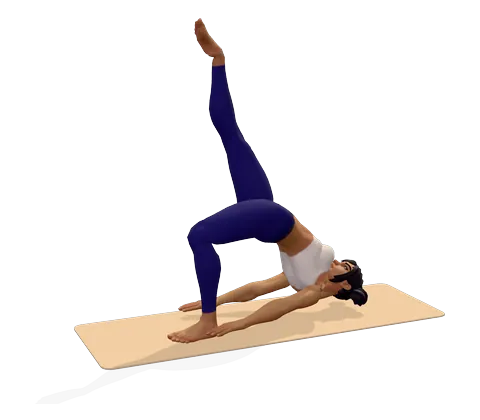
How to do One-Legged Bridge Pose step by step
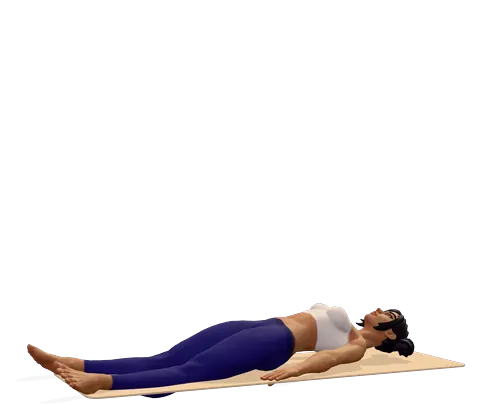
- Lie on your back with your knees bent and your feet flat on the mat, hip-width apart, heels a hand-length from your hips.
- Rest your arms beside your body with the palms down. Keep the back of your neck long and your chin slightly tucked.
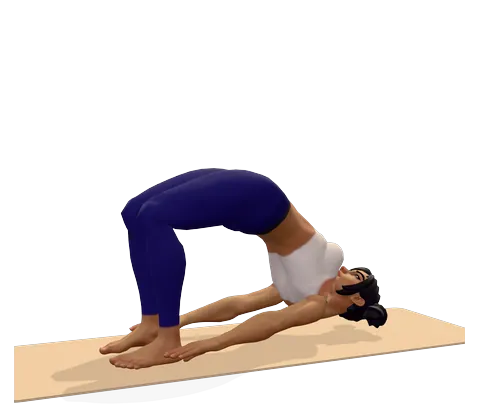
- Breathe in, press evenly into both feet and lift your hips into bridge pose. Check that your knees point straight forward.
- Shift a little weight into your left foot. Breathe out and lift your right foot, then straighten the right leg up toward the ceiling.
- Keep both hips at the same height by pressing the left foot down and squeezing the left buttock. Your thighs stay parallel.
- Hold for 3–5 breaths (about 20 seconds). Do not turn your head while your neck is under load.
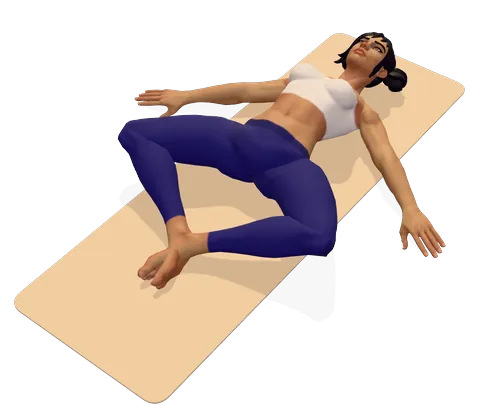
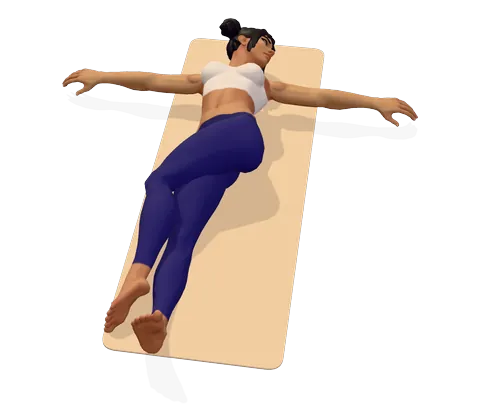
- Bend the right knee, place the foot back on the mat and roll your spine down slowly. Rest, then repeat with the left leg lifted.
Where you feel One-Legged Bridge Pose: what it stretches and strengthens
Keep your hips level as you lift one leg straight up. In the 3D guide, turn on Body guide: areas that stretch glow green and areas that work glow saffron.
Stretches
- Hip flexors
- Chest
Strengthens
- Glutes
- Hamstrings
- Lower back
Benefits and precautions
Benefits
- Strengthens the glutes and hamstrings of the standing leg much more than two-legged bridge
- Trains the deep core and hip muscles to keep the pelvis level
- Stretches the front of the hips and opens the chest
- Shows up strength differences between the left and right side
- Used in yoga and physiotherapy programmes for lower back and hip strength
- Prepares you for one-legged shoulder stand and one-legged wheel pose
Avoid or modify if
- Neck injury or neck pain — keep the head still and use a folded blanket under the shoulders, or skip the pose
- Recent back injury or a disc problem that flares with bending back — ask your physiotherapist first
- Knee pain in the standing leg — move the foot slightly further from the hips or stay in two-legged bridge
- Pregnancy after the first trimester — avoid long holds lying on your back; a short, low bridge may be fine with your midwife's approval
- Stop if you feel a cramp in the hamstring; lower the lifted leg and lengthen the standing leg
One-legged bridge pose (Eka Pada Setu Bandhasana) starts in ordinary bridge pose and then lifts one leg straight up to the ceiling. Taking one foot away doubles the work for the other side, so a gentle backbend becomes a real strength exercise for the glutes, hamstrings and core. Gym trainers know it as the single leg bridge; yoga teachers use it to build stable hips before deeper backbends. This guide explains the Sanskrit name, how to do it well, the muscles worked, progressions and who should be careful.
What is one-legged bridge pose?
It is a variation of setu bandhasana, bridge pose, in which you lie on your back, lift the hips and then raise one leg. In Sanskrit, eka means "one", pada "foot" or "leg", setu "bridge" and bandha "lock" or "binding". The full classical name is Eka Pada Setu Bandha Sarvangasana, because the shoulders and upper back rest on the floor as in a shoulder stand (sarvanga means "whole body").
Is bridge pose a backbend?
Yes, a mild one. The spine arches gently from the shoulders to the hips while the chest moves toward the chin. In the one-legged version the backbend stays about the same, but the balance and strength demand is much higher.
What is a single leg bridge in fitness?
Is this bridge pose a yoga pose or a gym exercise? Both. Trainers do the same shape in repetitions; a single leg hip bridge or single leg glute bridge exercise targets one buttock at a time. The one-legged bridge pose in yoga asks you to stay still for a few breaths, which builds endurance and body awareness.
How to do a single leg bridge well
If you know how to do bridge pose, you already have the base. These cues make the one-legged bridge exercise safe and effective:
- Lift from two feet first. Always come into a normal bridge, then lift the leg. Pushing up from one foot strains the knee and lower back.
- Level hips. The hip on the lifted-leg side usually drops. Press the standing foot down and imagine a glass of water balanced on your belly.
- Knee over ankle. The standing knee points straight ahead, not in or out.
- Straight or bent top leg. The 3D guide shows a straight leg up to the ceiling. If your hamstrings are tight, keep a soft bend.
- Quiet neck. Keep your head still and your gaze up; never turn to look around in any bridge.
Feel it mostly in the buttock and the back of the thigh of the standing leg. If your lower back does most of the work, lower the hips a little and squeeze the glutes more.
One-legged bridge pose benefits
What does bridge pose do? It strengthens the back of the body and opens the front. The single leg glute bridge benefits go further because each side has to work on its own:
- Stronger glutes and hamstrings. Research on bridge exercises shows that muscle activity in the glutes and hamstrings rises clearly when one leg is lifted.
- Pelvic control. Keeping the hips level trains the small hip muscles and the deep abdominal muscles, which matter for walking, running and climbing stairs.
- Left–right balance. Most people find one side harder. Practising both sides helps even this out.
- Hip flexor and chest stretch. The front of the standing hip and the chest open, a useful counter to long sitting.
Are bridges good for back pain?
Often, yes. Bridges for back pain are common in physiotherapy because strong glutes take load off the lower back, and yoga programmes for chronic back pain have been shown to reduce pain and disability. As a yoga pose for lower back pain, start with the two-legged bridge exercise and only move on when it feels easy. Can you bridge with spinal precautions? After spinal surgery or with a fracture, only if your surgeon or physiotherapist says so.
Single leg bridge muscles worked
| Works (standing leg and trunk) | Stretches |
|---|---|
| Gluteus maximus and gluteus medius | Hip flexors of the standing leg |
| Hamstrings | Chest and front of the shoulders |
| Muscles along the lower spine | Hamstrings of the lifted leg (when straight) |
| Deep abdominals and obliques | Front of the neck, gently |
The muscles used in bridge pose are the same in both versions; the single leg hamstring bridge simply loads them harder. Press the Body guide button in the 3D viewer to see the stretched areas glow green and the working areas glow saffron.
Setu Bandha Sarvangasana for beginners: props and progressions
Easier versions
- Low double leg bridge: lift the hips only a little and hold. This is the best of the prep poses for bridge pose.
- Supported bridge pose: place a yoga block under your sacrum and lift one leg from there. The block takes the weight so you can learn the leg position.
- Modified single leg bridge: lift the foot only a few centimetres off the mat, knee bent.
- Single leg bridge with march: lift one foot, lower it, lift the other. This bridge with single leg raise builds control before a longer hold.
Single leg bridge progressions
- Single leg bridge hold: work up from 3 breaths to 30 seconds each side.
- Single leg bridge with band: a loop band around the thighs makes the outer hip work harder.
- Single leg bridge on bench, box or chair: placing the heel on a raised surface increases the range and hamstring load.
- Single leg bridge with weight: in a gym, a dumbbell resting on the hips adds load. Keep it for when bodyweight holds are easy.
- One-legged wheel pose: an advanced cousin done from full wheel pose. Only attempt it with a steady wheel.
Physiotherapists sometimes use a single leg bridge endurance test, counting how long or how many times you can hold the lift on each side, to compare the two legs. If one side is much weaker, spend a little more time on it.
Precautions
These Setu Bandha Sarvangasana precautions apply to both versions. The main risks are to the neck, from moving the head under load, and to the lower back, from lifting too high with weak glutes. Keep the hips at a height you can hold level and come down if you feel pain rather than muscle effort. Breathe smoothly; never hold your breath.
When and how often to practise
Like most one-legged yoga poses, it is hard work, so two or three times a week is enough for strength gains. Warm up with cat pose and a few two-legged bridges, and rest afterwards in happy baby or a gentle knees-to-chest hold. It fits well into a core or glute routine; add it to your own flow in the sequence builder, or practise bridges in the guided back pain relief session.
एक पाद सेतु बंधासन (Eka Pada Setu Bandhasana) — हिंदी में: पीठ के बल लेटें, घुटने मोड़ें और पैर ज़मीन पर रखें। साँस लेते हुए कूल्हे ऊपर उठाएँ, फिर एक पैर सीधा छत की ओर उठाएँ। दोनों कूल्हे बराबर ऊँचाई पर रखें और 3–5 साँस रुकें, फिर दूसरी तरफ़ करें। इससे कूल्हे, जाँघ के पीछे की मांसपेशियाँ और कमर मज़बूत होती है। गर्दन या कमर में चोट हो तो पहले डॉक्टर से सलाह लें।
Frequently asked questions
What are the benefits of one-legged bridge pose?
It strengthens the glutes, hamstrings and core far more than two-legged bridge, trains you to keep the pelvis level, stretches the front of the hip and chest, and shows up strength differences between your left and right side.
What is one-legged bridge pose called in Sanskrit?
Eka Pada Setu Bandhasana, or in full Eka Pada Setu Bandha Sarvangasana: eka = one, pada = leg, setu = bridge, bandha = lock. Bridge pose in Sanskrit is Setu Bandhasana.
How long should I hold a single leg bridge?
Start with 3 breaths on each side and build to about 20–30 seconds. In a gym you can do 8–12 slow lifts per side instead of a hold.
Is the single leg bridge good for lower back pain?
It can help once the two-legged bridge is easy, because strong glutes support the lower back. If your back hurts during it, go back to the two-legged version and ask a physiotherapist.
Why do I feel a single leg bridge in my hamstring and not my glutes?
Your foot may be too far from your hips, or the glutes are not switched on. Bring the heel closer and squeeze the buttock of the standing leg before you lift the other leg.
Why does my hip drop when I lift one leg?
The hip muscles of the standing side are not yet strong enough to hold the pelvis level. Lower the hips slightly, try the marching version or use a block under the sacrum.
What is a good single leg glute bridge alternative?
Two-legged bridge with a pause at the top, a supported bridge on a block, or locust pose if lying on your back is uncomfortable.
This page is for general education. Check with your doctor before starting yoga if you are pregnant, have a medical condition or an injury. Stop if you feel pain, dizziness or shortness of breath.