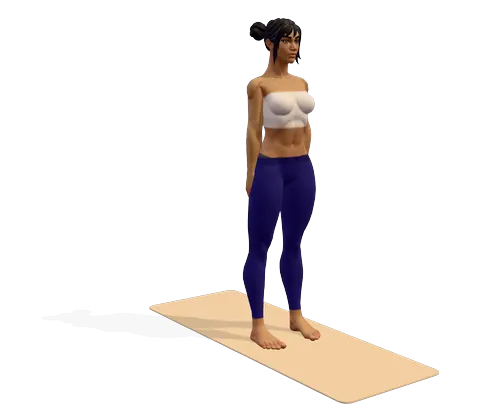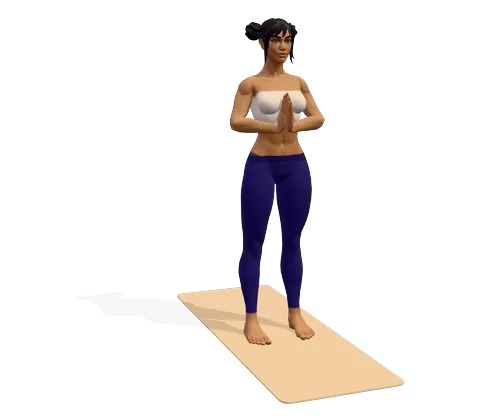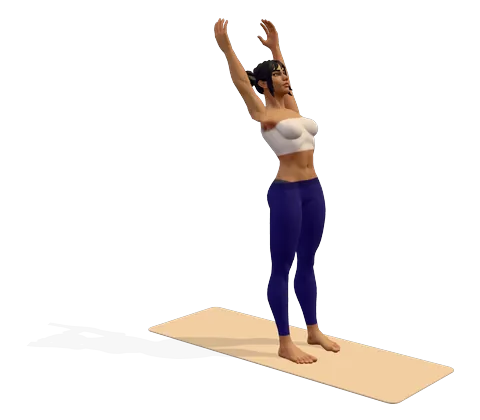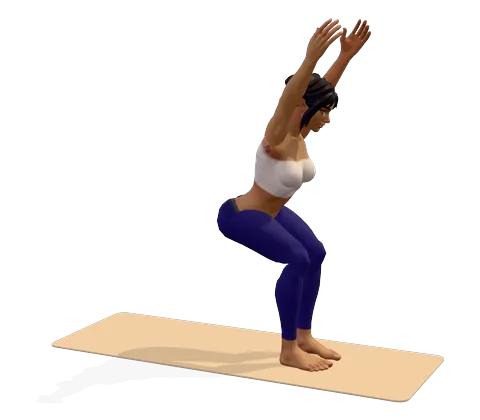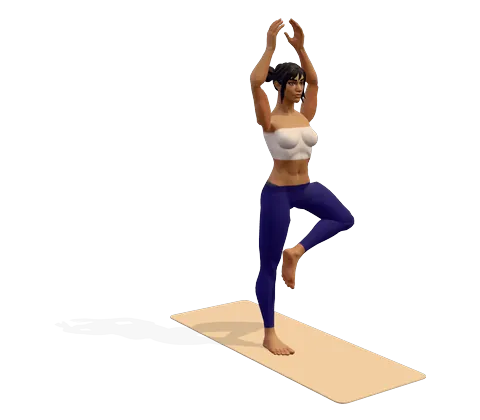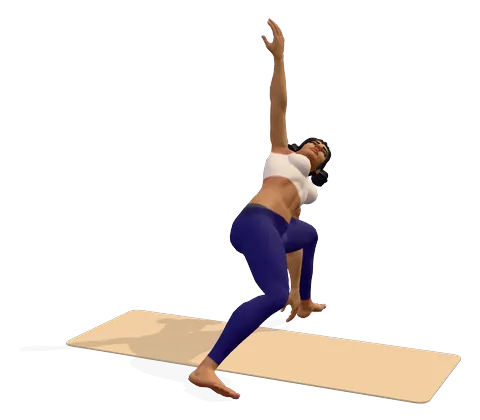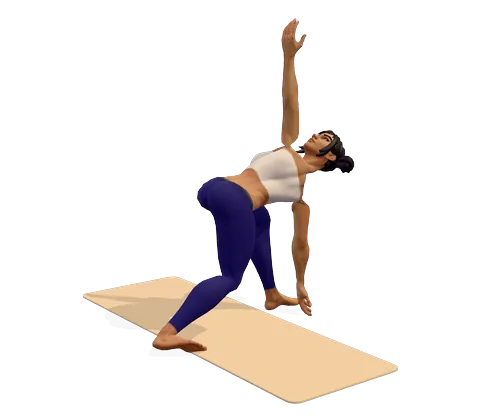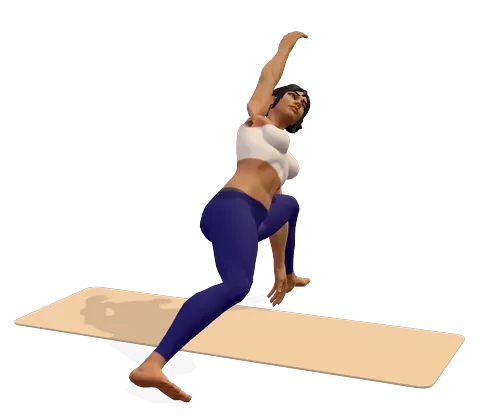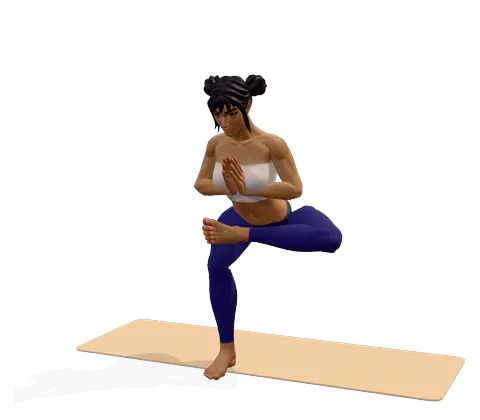
How to do Standing Figure Four Pose step by step
- Stand in Mountain Pose. Shift your weight onto your right foot and bend both knees a little.
- Lift your left foot and cross your left ankle over your right thigh, just above the knee. Flex your left foot so the toes pull back toward the shin.
- Bring your palms together at the centre of your chest.
- Bend your right knee more and sit your hips back as if onto a chair. Let your left knee drop open to the side.
- Lean your chest forward a little with a long, straight spine until you feel a stretch in the outer left hip. Look at a steady point on the floor ahead.
- Hold for 20–30 seconds (3–5 breaths), keeping the standing knee over the middle of the foot.
- Rise up, uncross your leg and place the left foot down. Repeat standing on the left leg.
Where you feel Standing Figure Four Pose: what it stretches and strengthens
Sit back and let your crossed knee drop open. In the 3D guide, turn on Body guide: areas that stretch glow green and areas that work glow saffron.
Stretches
- Glutes
- Hip flexors
Strengthens
- Front thighs
- Ankles
- Abs
Benefits and precautions
Benefits
- Stretches the outer hip and glutes of the crossed leg, including the deep hip rotators
- Strengthens the thigh (quadriceps), ankle and foot of the standing leg
- Trains balance and steady focus on one leg
- Engages the core muscles that keep the torso steady
- A practical standing alternative to Pigeon Pose for tight hips
- Prepares for arm balances such as Flying Pigeon
Avoid or modify if
- Knee injury: keep the crossed foot flexed and the ankle above the knee, never on the kneecap; skip it if the knee hurts
- Poor balance or vertigo: stand with your back near a wall or hold a chair, or do the seated version
- Hip replacement: crossing the legs may be restricted after surgery; follow your surgeon or physiotherapist
- Ankle sprain or weak ankles: bend the standing knee less and stay near support
- Pregnancy: balance changes; do the seated chair version or hold a wall
Standing figure four pose (Eka Pada Utkatasana) is a balance and hip stretch in one. You stand on one leg, cross the other ankle over the standing knee so your legs make the number 4, and sit back into a small chair shape. The outer hip of the crossed leg stretches while the standing leg works. Among one legged yoga poses, this figure four yoga pose is one of the most useful for runners, walkers and anyone who sits a lot.
What is standing figure four pose? Sanskrit name
The standing figure 4 pose in Sanskrit is Eka Pada Utkatasana: eka means "one", pada means "foot" or "leg", utkata means "fierce" or "powerful" and asana means "pose". So the name means one-legged fierce pose, which is why yoga teachers also call it one legged chair pose or single leg chair pose. It is the same shape as the reclined figure 4 pose (Eye of the Needle), just standing up, and some teachers use the figure 4 pose Sanskrit name Sucirandhrasana for the lying version only.
How to do standing figure four pose well
The steps above match the 3D figure, which balances on the right leg first with the left ankle crossed. What makes the difference:
- Flex the crossed foot. Pulling the toes back protects the knee of the crossed leg.
- Ankle above the knee, not on it. Rest the ankle bone on the lower thigh.
- Sit back, then lean. The stretch grows as the hips go back and the chest comes forward with a straight spine.
- Standing knee over the foot. Do not let it drift inward.
- Fix your gaze. One still point on the floor makes the balance much easier.
Feel the stretch in the outer hip of the crossed leg. Sharp knee pain means come out.
What are the standing figure four pose benefits?
The standing figure four stretch targets the glutes and the deep rotator muscles at the back of the hip, including the piriformis. Meanwhile the standing leg builds strength in the quadriceps and ankle, and the core works to keep you upright. Among one leg balancing yoga poses, this one gives you a stretch as well as the balance work.
| Stretched | Worked |
|---|---|
| Glutes and deep hip rotators of the crossed leg | Quadriceps of the standing leg |
| Outer hip and the front of the hip joint | Ankle and foot muscles (balance) |
| Lower back, mildly, as you lean forward | Abdominals and back muscles (steadying the torso) |
Because it opens tight hips, it often appears in routines for hip pain and tight hips. People with sciatica sometimes find the piriformis stretch helpful, but go gently and see our yoga for sciatica page first.
Beginner, chair and wall versions
- Wall or chair support: hold the back of a chair or rest one hand on a wall. This makes it one of the simple chair yoga poses you can do standing.
- Seated figure four sitting position: sit on a chair, cross one ankle over the other knee and lean forward with a long back. Of all yoga poses sitting in a chair, this is one of the best seated chair yoga poses for beginners and seniors.
- Figure 4 pose on your back: the supine figure 4 pose removes balance completely, so you can relax into the stretch.
Standing figure 4 prep poses and variations
Good standing figure 4 prep poses are Chair Pose (learn how to do yoga chair pose on two legs first), Tree Pose for standing on one leg, and the reclining figure 4 pose yoga stretch on your back.
Standing figure 4 yoga pose variations for more experienced students:
- Hands to the floor: fold further and place your fingertips on the floor or on blocks.
- Revolved figure 4 pose: twist toward the crossed leg, a close cousin of revolved chair pose in yoga. Only do this if your balance is steady.
- Flying Pigeon: from a deep forward fold, the hands go to the floor, the crossed foot hooks behind the upper arm and the back leg lifts. This is Eka Pada Galavasana, an advanced arm balance.
Pigeon pose vs figure 4
Both stretch the same outer hip. Pigeon Pose is done on the floor and puts more weight into the front knee and hip, so it can be intense. In yoga, standing figure four pose and the lying figure four let you control the depth, which is kinder to sensitive knees.
Is it a good yoga pose for back pain?
Tight hips and glutes can pull on the lower back, so easing them may help some people with general back stiffness. The seated chair version is one of the gentler chair yoga poses for back pain. If you have a disc problem or pain that shoots down the leg, ask your physiotherapist first. You can practise hip-friendly sequences with voice in our guided sessions.
एक पाद उत्कटासन (One legged chair pose in Hindi): दाएँ पैर पर खड़े होकर घुटना थोड़ा मोड़ें। बाएँ टखने को दाएँ घुटने के ठीक ऊपर जाँघ पर रखें और पंजा मोड़कर रखें। हथेलियाँ छाती के सामने जोड़ें, कूल्हे पीछे ले जाएँ और 20–30 सेकंड रुकें, फिर पैर बदलें। यह कूल्हों की जकड़न कम करने और संतुलन बढ़ाने में मदद करता है। संतुलन कमज़ोर हो तो दीवार या कुर्सी का सहारा लें।
Frequently asked questions
What is standing figure four pose good for?
It stretches the outer hip and glutes of the crossed leg, strengthens the standing leg and ankle, and trains balance. It is a practical standing hip opener.
Is standing figure four the same as one legged chair pose?
Yes. Eka Pada Utkatasana means one-legged chair pose; in English it is also called standing figure four pose because the legs form the number 4.
Why does my knee hurt in figure four pose?
Usually the crossed foot is not flexed or the ankle is resting on the kneecap. Flex the foot, move the ankle up onto the thigh and bend the standing knee less. Stop if the pain continues.
Can I do figure four pose in a chair?
Yes. Sit tall, cross one ankle over the other knee and lean forward with a straight back. It gives the same hip stretch with no balance needed.
Is standing figure four a hard balance?
It is moderate. Standing poses in yoga on one leg, like all single leg yoga poses, take practice. Hold a wall at first; most people can let go after a few weeks.
How long should I hold standing figure four?
Hold for 20–30 seconds on each side. The lying version can be held for a minute or more.
This page is for general education. Check with your doctor before starting yoga if you are pregnant, have a medical condition or an injury. Stop if you feel pain, dizziness or shortness of breath.