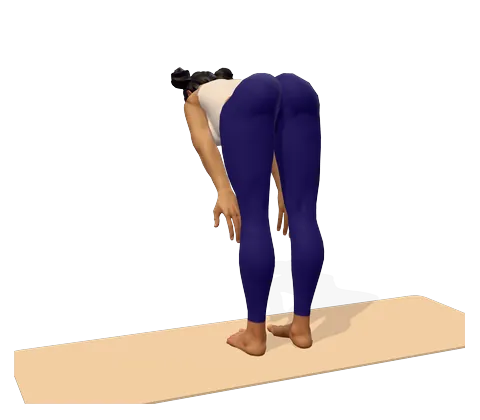
How to do Half Standing Forward Bend step by step
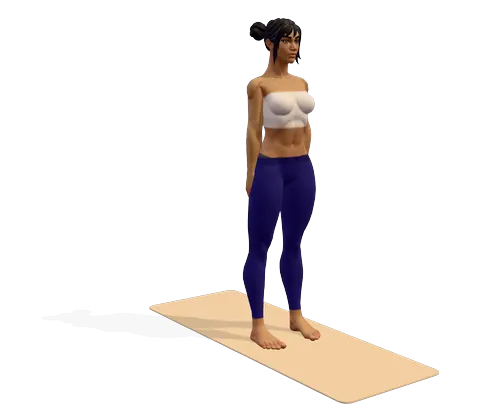
- Stand in Mountain pose with your feet hip-width apart. Breathing out, fold forward from your hips into a standing forward bend, knees soft.
- Place your hands on your shins, just below your knees. Bend the knees more if you cannot reach without rounding.
- Breathing in, lift your chest halfway up and slide your shoulder blades toward your hips.
- Lengthen your spine forward until your back is flat, about parallel to the floor, like a table. Keep your legs straight but not locked.
- Look at the floor a little in front of your feet so the back of your neck stays long, in line with the spine.
- Hold for 2–3 breaths (about 15 seconds), reaching the crown of your head forward and your hips back.
- Breathing out, fold back down into the forward bend, or bend your knees and roll up slowly to standing.
Where you feel Half Standing Forward Bend: what it stretches and strengthens
Lengthen your spine forward so your back is flat like a table. In the 3D guide, turn on Body guide: areas that stretch glow green and areas that work glow saffron.
Stretches
- Hamstrings
- Calves
Strengthens
- Upper back
- Lower back
- Spine
Benefits and precautions
Benefits
- Strengthens the muscles along the spine and the upper back
- Stretches the hamstrings and calves in a gentle way
- Teaches the hip hinge, the safe way to bend forward
- Helps posture by training a long, neutral spine
- Links forward folds in Sun Salutation and prepares you for deeper ones
- Easy to do anywhere, even with a chair or a wall
Avoid or modify if
- Acute lower back pain, a slipped disc or sciatica — bend your knees a lot, put your hands on your thighs and stop if pain spreads down a leg
- Hamstring strain — keep the knees bent and lift only as far as is comfortable
- Low blood pressure or dizziness — come up slowly and keep your head above your heart when possible
- Recent heart or chest surgery (sternal precautions) — ask your surgeon or cardiac rehab team before bending forward
- Late pregnancy — take a wider stance, hands on a wall or chair, and ask your midwife or doctor
Ardha Uttanasana, the halfway lift or half standing forward bend, is a simple pose in which you hinge at the hips with a flat back and your hands on your shins. You probably know it from Sun Salutation, where it comes between the forward fold and the step or jump back. It looks easy, but the halfway lift teaches one of the most useful movements in yoga and daily life: bending forward from the hips with a long spine.
What is Ardha Uttanasana?
Ardha Uttanasana in English and in Sanskrit
The name breaks down into ardha ("half"), ut ("intense"), tan ("to stretch" or "extend") and asana ("pose"). So the literal translation is "half intense standing forward bend" or half intense stretch pose. In English classes you will hear halfway lift, half lift, flat back pose, standing half forward bend and half standing forward fold. All are the same pose. The Ardha Uttanasana pronunciation is roughly ARD-hah OOT-tan-AHS-ah-nah.
In Ardha Uttanasana yoga practice, "halfway" is the key word: the chest lifts only half of the way up, so the torso ends parallel to the floor, or a little higher if your hamstrings are tight.
How to do the halfway lift (flat back yoga pose)
The steps above match the 3D guide. Start from Uttanasana (standing forward bend), slide your hands up to your shins and lengthen. The whole movement happens at the hips; the spine does not bend or round. That is why teachers call this standing half forward bend yoga pose the flat back pose in yoga classes.
Halfway lift cues
- "Long spine, not high chest." Reach the top of your head forward, not up. Lifting too high arches the lower back.
- "Hips back over the heels." Your weight stays in the middle of the feet, not in the toes.
- "Shoulders away from the ears." Draw the shoulder blades toward the hips so the neck is free.
- "Knees soft if you need it." Tight hamstrings pull the pelvis under and round the back; bending the knees fixes this.
- "Eyes on the floor ahead." Looking forward at the wall crunches the neck.
Common mistakes in these Ardha Uttanasana cues are the same everywhere: a rounded upper back, locked knees and a chin pushed forward.
Ardha Uttanasana benefits
The main benefits of the halfway lift are strength and awareness in the back. Holding the torso flat against gravity works the long muscles along the spine and the upper back, while the hamstrings and calves get a mild stretch. It is a milder version of the full fold, so standing half forward bend benefits suit stiff bodies and beginners well.
It also trains the hip hinge. The proper way to lift a heavy box uses the same idea: bend at the hips and knees with a long spine rather than rounding. Learning it on the mat can help you move more safely in daily life. It fits well into yoga for posture and yoga for office workers routines.
Muscles stretched and worked
| Stretched | Strengthened |
|---|---|
| Hamstrings | Muscles along the spine (lower back) |
| Calves | Upper back, between the shoulder blades |
Half standing forward bend on the wall and with a chair
What is half standing forward bend on the wall? It is the same shape with your hands pressing into a wall at hip height. Stand about one arm-length plus a step from the wall, place your palms flat and walk your feet back until your back is flat and your arms are in line with it. It stretches the shoulders too and takes weight off the back. This is how to do half standing forward bend on the wall safely if you are a beginner or have back pain.
For chair yoga forward bend practice, rest your hands on the back of a chair instead of the wall. Seniors often find this version the most comfortable.
Is it good if my lower back hurts when I bend forward?
Lower back pain when bending forward is common, and it often comes from rounding the lower spine. Some people find their back pain is relieved with bending forward, others find it worse; both are reasons to move carefully. If your lower back pain means you can't bend forward at all, skip the pose and see a professional. The halfway lift with bent knees, or the wall version, can be a gentle way to practise bending with a neutral spine. Keep your hands high on your thighs and move slowly. If you have a slipped disc, sciatica or sharp pain, see our yoga for back pain plan and ask your doctor or physiotherapist first. Stop if pain spreads down a leg.
Halfway lift in Sun Salutation
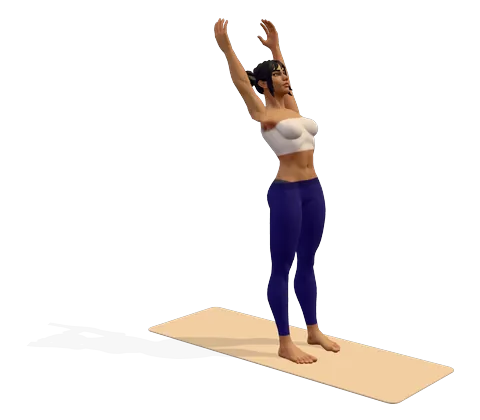
In the Vinyasa style of Surya Namaskar, the sequence goes: raised arms, forward fold, halfway lift, then the step or jump back to plank. On the way back up, the order reverses. One of the benefits of Hasta Uttanasana and the halfway lift together is that they balance the rounding of the forward fold with lengthening.
Half standing forward bend vs other yoga forward bend poses
- vs Uttanasana: the full standing forward bend lets the head hang and gives a deeper hamstring stretch; the halfway lift is active and strengthens the back.
- vs wide leg forward bend: Prasarita Padottanasana is a standing wide forward bend that also stretches the inner thighs.
- vs single leg forward bend: Pyramid pose folds over one leg, a stronger stretch.
- vs seated forward bend yoga pose: Paschimottanasana works the same hamstrings sitting down, without the standing strength.
Practise it with voice guidance in our guided yoga sessions, or learn the basics first with yoga for beginners.
Frequently asked questions
What is Ardha Uttanasana in English?
It means half standing forward bend. It is also called the halfway lift, half lift or flat back pose.
What does halfway mean in the halfway lift?
Halfway means you lift your chest only half of the way up from the forward fold, so your back is flat and roughly parallel to the floor.
What are the benefits of the halfway lift?
It strengthens the back muscles, gently stretches the hamstrings and calves, improves posture awareness and teaches the hip hinge.
Should my legs be straight in the halfway lift?
Straight but not locked if your hamstrings allow a flat back. If your back rounds, bend your knees as much as you need.
Where do my hands go in Ardha Uttanasana?
On your shins just below the knees, on your thighs, or on blocks. Fingertips on the floor only if your back still stays flat.
How long should I hold the halfway lift?
Usually 1–3 breaths in a flow. On its own you can hold it for 15–30 seconds.
Can you bend forward with sternal precautions?
Ask your surgeon or cardiac rehab team first. After chest surgery you often have sternal precautions, and the wall version with hands high may be advised later.
This page is for general education. Check with your doctor before starting yoga if you are pregnant, have a medical condition or an injury. Stop if you feel pain, dizziness or shortness of breath.